
You're Here Because Crypto Trading Looks Like Free Money (It Isn't)
Let's get the uncomfortable stuff out of the way first:
Most new crypto traders lose money. Not because they're stupid, because they're underinformed. They enter trades based on Twitter sentiment, YouTube "gurus," or gut feeling. Meanwhile, institutional traders and whales are using data those retail traders don't even know exists.
This guide covers what you need to know to trade crypto profitably: the mechanics, the risks, the tools that matter, and how to stop being the liquidity that pays for everyone else's profits.
What Crypto Trading Is
The Short Version
Buying and selling cryptocurrencies to profit from price movements. Holding periods from minutes to weeks. Active management required. High risk, high potential reward.
Spot vs Perpetual Futures (The Big Distinction)
Spot trading: You buy actual $BTC or $ETH. You own it. If price drops 50%, you still own it (worth less, but you're not liquidated). Simple. Lower returns. Lower risk.
Perpetual futures ("perps"): You're trading contracts that track the asset price without ever owning it. Leverage is available (2x up to 125x on some exchanges). Your position gets liquidated (force-closed at a loss) if price moves enough against you.
Most serious crypto trading happens in perps. That's where the volume is, where the edge lives, and where Kingfisher's data provides the most value. This guide focuses on perp trading because that's where you'll learn whether trading is for you. If you're new to leverage, read the leverage trading guide first. It covers the mechanics of margin and liquidation in detail.
If you only want to buy and hold: Buy $BTC on Coinbase or similar. Set up cold storage. Check back in a year. Done. You don't need a trading guide or analytics platform for that.
The Three Things That Kill New Traders (And How to Avoid Them)
Killer #1: Overleveraging
New traders see "100x leverage" and think it means "100x profits." It means the opposite.
How leverage works:
| Leverage | Your Capital | Position Size | Price move to liquidate you |
|---|---|---|---|
| No leverage (spot) | $10,000 | $10,000 | Never (you just hold through drops) |
| 3x | $10,000 | $30,000 | ~33% drop |
| 10x | $10,000 | $100,000 | ~10% drop |
| 50x | $10,000 | $500,000 | ~2% drop |
$BTC moves 3-5% on a normal day. At 10x leverage, one normal day can wipe your position. At 50x, a single wick does it.
Where professionals live: 2x-5x leverage maximum. Enough to amplify wins without amplifying losses into account death. If you need more than 5x to make meaningful returns, your account is too small for the strategy, not the other way around.
Killer #2: No Risk Management
Three rules. Non-negotiable.
Rule 1: Never risk more than 1-2% of your account on a single trade.
$10K account? Max loss per trade = $100-$200. That means if you take 10 losing trades in a row (it happens), you've lost 10-20% and you're still in the game. Risk 10% per trade and 10 losers = 100% gone.
Rule 2: Always use a stop-loss.
A predetermined exit point where you admit the trade isn't working. Set it when you enter, not when you're emotional about a losing position. Kingfisher's position size calculator will tell you exactly where your stop should go based on cluster data.
Rule 3: Never add to a losing position.
"Averaging down" sounds smart. In leveraged perp markets, it's how accounts die. Every addition to a losing position brings your blended liquidation price closer to current market. You're digging faster, not recovering.
Killer #3: Trading Without Information
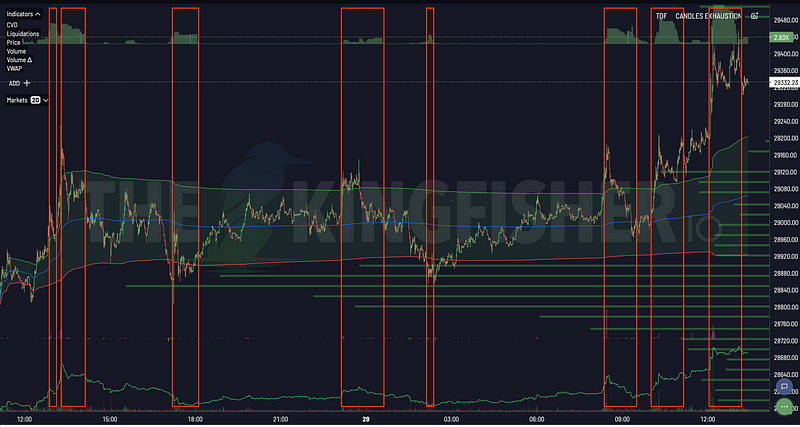
You enter long on $ETH because "the chart looks bullish." Someone else enters because their LiqMap shows a $2B short cluster above current price, GEX+ confirms negative gamma above $3,400 (dealers will amplify upward moves), TOF shows whale buy aggression, and funding is moderate.
Who do you think has better odds?
This isn't about having expensive tools. It's about making decisions based on structural market data rather than price patterns that everyone can see.
Understanding Market Structure (What Most Guides Skip)
Liquidation Clusters: Where the Fuel Lives
When thousands of traders open leveraged positions, those positions cluster at specific price levels. Why? Round numbers, technical levels, psychological barriers. Doesn't matter why. What matters is: when price reaches those levels, all those positions get force-closed simultaneously.
That forced closing creates cascades. A $3B long cluster at $64,000 means $3B of forced selling if price breaks $64K. That selling pushes price lower, which triggers MORE liquidations at the next cluster down. Chain reaction.
Kingfisher's Liquidation Map shows you these clusters in real time. Green zones below price = longs that cascade if broken. Red zones above = shorts that squeeze if breached.
Why this matters for beginners: Instead of setting your stop-loss at a random level "below support," you set it below a major long cluster (because clusters act as support until they don't). Instead of guessing a target price, you target the short cluster above (because price is magnetized toward fuel).
Open Interest: Who's in the Game
Open Interest (OI) = total value of all active futures contracts. Rising OI means new money entering (or new shorts in a downtrend). Falling OI means positions closing (unwinding).
The four scenarios:
| Price | OI | Meaning |
|---|---|---|
| Up | Up | New buyers entering (strong trend) |
| Up | Down | Shorts covering (weak rally) |
| Down | Up | New shorts entering (strong downtrend) |
| Down | Down | Longs liquidating (potential bounce) |
Beginner application: Don't enter longs when price is rising but OI is falling. That's a weak rally built on short-covering, not new demand. Wait for OI confirmation.
Funding Rates: The Crowd Meter
Every 8 hours on perpetual futures, longs pay shorts (or vice versa) based on where the perp trades relative to spot price. The funding rate tells you which side is crowded.
Normal range ($BTC): +/-0.01-0.03% per 8 hours. Nothing extreme. Extreme positive (+0.05%+): Longs are overcrowded. Everyone is paying to be long. Contrarian warning. Extreme negative (-0.05%+): Shorts are overcrowded. They're paying to be short. Squeeze candidate.
Beginner application: Don't enter longs when funding is positive. You're buying into the most crowded trade possible. Either wait for normalization or consider the fade.
Your First Trade: A Complete Example
Let's walk through exactly what a structured first trade looks like using Kingfisher data.
Step 1: Pull the LiqMap
Open Liquidation Maps for $BTC. Current price: $67,000.
ABOVE PRICE:
  $69,500: $2.1B in short liquidations (red zone)
  → Target if bullish. Short squeeze fuel.

CURRENT PRICE: $67,000

BELOW PRICE:
  $64,000: $4.8B in long liquidations (green zone)
  → Support with consequences. Stop goes below here.
  $61,500: $1.3B in long liquidations
  → Secondary support / cascade target
Step 2: Check GEX+ (Dealer Positioning)
GEX+ shows positive gamma between $65K-$68.5K. Flip level at $68,500.
Interpretation: Dealers are supporting this range (buying dips, selling rips). Range-bound environment. Good for buying dips toward support, not for chasing breakouts.
Step 3: Verify OI and Funding
OI trending up with price over past week = new buyers entering, not just short covering. Funding at +0.017% = moderate, not extreme. Safe zone for longs.
Step 4: Formulate the Trade
- Entry: Limit order at $65,200 (near the $4.8B long cluster support)
- Stop-loss: $63,800 (below the cluster, if this breaks, thesis is wrong)
- Target 1: $68,200 (GEX flip level), take 50% profit here
- Target 2: $69,500 (short cluster), remaining position
- Risk/Reward: Risking $1,400 to make $1,500 (target 1) or $4,300 (target 2)
- Position size: 1.5% of account ($150 on $10K account)
Step 5: Execute and Monitor
Set the limit order. Set alerts:
- "$BTC within 1% of $64,000" (cluster test warning)
- "$BTC crosses $68,200" (target 1 approach)
Check LiqMap daily: are clusters still there? Check GEX+, regime unchanged? If anything changes materially, reassess.
This isn't guesswork. It's a trade built on multiple confirming data points, each telling you something specific about market structure. Compare that to "I think $BTC looks bullish."
Choosing an Exchange
For Derivatives Trading (Perps)
If you're trading spot, any major exchange works (Coinbase, Kraken, etc.). But for perp trading, where Kingfisher's data shines, you need a derivatives-focused exchange:
Top tier (where most volume lives):
- Binance. Largest perp volume. Most pairs. Best liquidity.
- Bybit. Clean interface. Strong perp focus. Retail-heavy user base.
- OKX. Solid alternative. Asian-hours strength.
Important note: Kingfisher doesn't connect to your exchange. We don't hold your funds or execute trades. We provide data. You trade wherever you want using whatever you learn from our tools.
Account Setup Basics
- Email + password + 2FA (use authenticator app, not SMS)
- KYC verification (ID + proof of address, takes 1-3 days)
- Deposit (bank transfer is cheapest, card is fastest)
- Start small ($50-100 to learn the interface before sizing up)
Security non-negotiables:
- Unique password (not reused anywhere)
- 2FA enabled before depositing anything
- Whitelist withdrawal addresses
- Never share your API keys or seed phrases
- Consider hardware wallet for holdings you won't trade soon
Building Your First Trading Plan
The Minimal Viable Plan
Don't overcomplicate this. A simple plan you follow beats a complex plan you ignore.
Define your approach:
- How much time can you dedicate? (30 min/day vs 4 hours/day)
- What's your risk tolerance? (1% max risk per trade = conservative)
- What's your capital? (Only trade what you can afford to lose)
- Which assets? (Start with $BTC and $ETH. Add others later.)
Your entry rules:
- I enter long when: specific conditions, e.g. price near long cluster + positive GEX + rising OI + normal funding
- I enter short when: specific conditions
- I do NOT enter when: conditions that disqualify a setup
Your exit rules:
- Take-profit target: based on opposite cluster or key level
- Stop-loss: below/above cluster invalidation level
- Max hold time: don't let trades drag beyond planned timeframe
Your position sizing:
- Standard risk: X% of account
- High conviction (multiple signals align): Y%
- Low conviction or conflicting signals: Skip
Write it down. Reference it before every trade. Update it as you learn.
Common Beginner Mistakes (And the Fixes)
Mistake 1: FOMO Entries
You see $SOL pumping 15% on Twitter. You FOMO in at the top. It dumps 20%. You're underwater.
Fix: Have a watchlist. Only trade assets you've researched and understand. If you missed a move, you missed it. Another one is coming. Chasing is how beginners donate capital to experienced traders.
Mistake 2: No Trading Journal
You take 50 trades. You have no idea which ones worked, why, or what you could improve. You're flying blind.
Fix: Log every trade: entry, exit, size, reason for entry, what happened, what you learned. Review weekly. Patterns will emerge. Your edge (or lack thereof) becomes visible.
Mistake 3: Switching Strategies Every Week
Monday you're a scalper. Wednesday you're a swing trader. Friday you're copying a Discord call. None of these approaches get time to work.
Fix: Pick ONE style. Master it over 2-3 months. Then consider adding another. Depth beats breadth every time in trading.
Mistake 4: Ignoring the Data You Have Access To
You subscribe to Kingfisher (or any analytics platform) but you still trade off gut feeling and chart patterns. The LiqMap sits open in a tab you never look at.
Fix: Make data review mandatory before EVERY trade. Pre-trade checklist: LiqMap checked? GEX+ confirmed? OI supports thesis? Funding safe? If you can't check all four, don't trade.
The Learning Path
Week 1: Create free Kingfisher account. Explore dashboard. Read your first LiqMap. Understand what green/red clusters mean. Do NOT trade with real money yet.
Week 2: Learn GEX+ basics. Understand OI interpretation. Practice reading funding rates. Paper trade based on KF data (write down what you'd do, then track what happened).
Week 3: Execute first 2-3 small live trades using complete workflow. Size tiny (0.5% risk). Focus on process, not profit.
Week 4: Review your journal. What worked? What didn't? Refine your plan. Decide whether to subscribe for continued access.
Month 2+: Build your personal playbook. Identify which KF tools matter most for your style. Optimize alert settings. Compound the edge.
Bottom Line
Crypto trading isn't a get-rich-quick scheme. It's a skill that takes time, discipline, and access to the right information. Most beginners fail because they're competing against better-informed participants while operating with worse data (or no data beyond price charts).
Kingfisher levels that playing field. The LiqMap shows where liquidation fuel is stacked. GEX+ reveals dealer positioning nobody else can see. TOF exposes whale order flow. OI and funding rates tell you who's crowded and who's exhausted.
Start with the 14-day free trial. No credit card. Full Pro access. See whether structural data changes how you trade. If it does (and for most people who use the tools, it does), you've found an edge worth keeping. If not, you lost nothing but a few hours of learning.
Start Your 14-Day Free Trial, Compare Kingfisher Plans
FAQ
Q: How much money do I need to start crypto trading realistically? A: You can start learning with $50-100 on a spot exchange, but for actual perp trading where Kingfisher's data shines, $500-$2,000 is a realistic starting point. The key isn't the amount. It's that you only trade what you can afford to lose entirely. Most beginners blow up because they overfund an account they don't know how to use yet. Start small ($100-200 per trade size), prove you can execute your system consistently, then scale up as your skills improve.
Q: Which Kingfisher tool should I learn first if I'm new? A: Start with the Liquidation Map, period. It's visual, intuitive, and immediately useful. It shows you where price is likely to bounce or break in a way that charts never will. Spend your first week just staring at the LiqMap for BTC until green/red clusters make sense. Week 2, add GEX+ basics. Week 3, check OI and funding. Trying to learn all tools at once is the #1 reason beginners quit within the first week.
Q: Can I make a living trading crypto with a small account under $10K? A: Realistically? Not as a full-time income. But you can build it into something meaningful. At $10K with proper risk management (1% per trade = $100 max loss), targeting 3-5% monthly returns (achievable with good setups), you're looking at $300-$500/month after 6-12 months of compounding skill development. The trap is trying to live off it too early and increasing risk to compensate. Keep your day job until your trading account can replace 50%+ of it sustainably.
Q: What's the single most important thing a beginner should do before their first trade? A: Write down your trading plan. Not in your head, on paper or in a document. Define: what makes you enter a trade, what makes you exit (both profit and loss), max risk per trade, which assets you'll trade, and maximum concurrent positions. Then follow it for 20 trades minimum before changing anything. The traders who survive are the ones who have rules before they have positions.
Q: How long until I'm profitable at this? A: Expect 3-6 months of consistent losses or break-even before becoming consistently profitable. That sounds discouraging but it's honest. And the traders who expect instant profits are the ones who blow up and quit. The learning curve in crypto is steep because of leverage, 24/7 markets, and emotional pressure. Using Kingfisher data shortens this timeline significantly because you stop guessing and start making structured decisions, but there's no shortcut around screen time and experience.