

What"s Happening Under Your Chart
You see a green candle. Price went up. Great.
But why did it go up? Was it real buying? A short squeeze? An iceberg order finally filling? Market maker hedging? Or some whale pushing price toward a liquidation cluster to trigger stops?
Most traders have no idea. They see the output (price movement) without understanding the inputs (order flow, liquidity, positioning). It"s like watching the scoreboard without knowing who"s playing or what game they"re playing.
Market structure is the machinery beneath the chart. Understanding it means you stop reacting to price moves and start anticipating them. You see where institutions are positioning, where the traps are set, and where the real opportunities hide.
This guide breaks down crypto market microstructure, not with academic theory, but with practical trading applications using Kingfisher"s data tools. The vwap entry breaks the mechanics down further. Kingfisher Success Stories: How Traders Actually Use the Data walks through this in more detail.
Order Types: Who Moves Price and How
Market Orders (Aggressive), "I Want In NOW"
Market orders execute immediately at whatever price is available. They remove liquidity from the order book.
Impact: Large market orders = significant price impact. The bigger the order, the worse your fill. In thin markets (altcoins, low-volume periods), a $1M market order on an illiquid pair can move price 1-2%. This slippage is why professional traders always account for execution cost in their risk management.
When to use: Entering momentum trades, exiting losing positions (stop-losses), any situation where execution speed matters more than price precision.
Crypto reality: Perp markets make market orders dangerously easy. One click at 20x leverage with a market order = zero price control. Always use limit orders for entries when possible.
Limit Orders (Passive), "I"ll Wait for My Price"
Limit orders sit in the order book waiting to be filled. They ADD liquidity.
Impact: No immediate price impact. But they create support/resistance levels. A wall of limit buy orders at $50,000 is real support until it gets eaten.
The catch: Limit orders can be cancelled. They"re intentions, not commitments. During volatile moves, the "support" you thought you had from visible limit orders can vanish in seconds as everyone cancels.
Key insight: Liquidation levels (from Kingfisher"s LiqMap) are NOT cancelable. When price hits a liquidation price, those positions WILL close. That makes liq levels harder support and resistance than limit orders. Because they can"t disappear.
Stop Orders (Conditional), "If Price Hits X, Execute Y"
Stop-losses and stop-entries. They sit dormant until triggered, then become market orders.
The cascade risk: This is where things get dangerous. A cluster of stop-losses at $50,000 creates a liquidity vacuum below. When price hits $50K, all those stops trigger simultaneously as market orders. The selling avalanche pushes price lower. More stops trigger. Cascade.
The LiqMap shows you exactly where these clusters of conditional orders live. That"s why it"s such a powerful tool. It maps the cascade triggers before anyone pulls them.
If any term here is new, the Volume Profile: How Traders Read Volume at Every Price Level entry covers it in depth.
Market Makers: The House Always Has Information Advantage
Who They Are
Traditional Makers: Provide bid-ask spreads, profit from spread, stay roughly delta-neutral. Their edge: they see order flow before you do.
HFTs (High-Frequency Traders): Ultra-fast execution, scalp spreads in microseconds. Volume-based business model. They don"t care about direction. They care about capturing the spread thousands of times per day.
AMMs (Automated Market Makers): DeFi protocols like Uniswap use algorithmic pricing instead of human makers. Code sets prices based on pool ratios. Different dynamics, same result, someone providing liquidity and earning spread.
How Market Makers Profit From You
The spread capture: Maker buys at $49,995, sells at $50,005. Spread = $10. Do this millions of times = serious money.
Information advantage: Makers see the full order book. They know where the big limit orders are, where the stops are clustered, where the thin spots are. Retail traders see a fraction of this.
Inventory management: When too many people buy from the maker, they get long (unbalanced). They hedge by selling into rallies or buying dips to rebalance. This hedging activity itself moves price. And the maker knows it"s coming before you do.
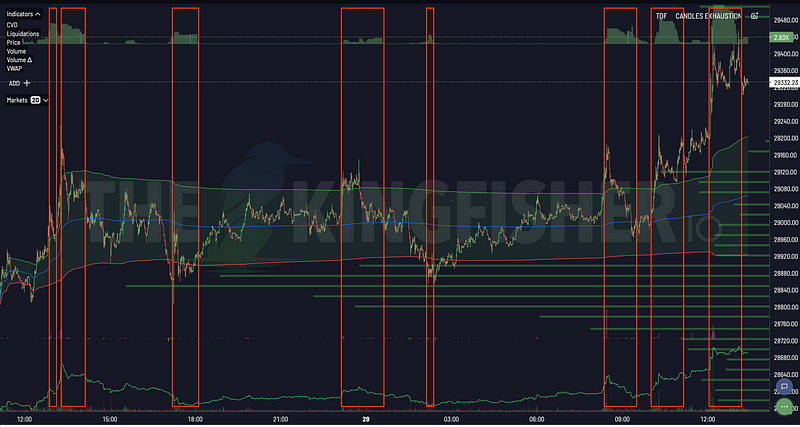
Toxic flow detection (Kingfisher"s ToF tool) reveals when makers are actively hedging against informed order flow. Spiking ToF = someone big is trading aggressively, and makers are adjusting. That information is your early warning system.
Liquidity: The Lifeblood of Every Trade
What Liquidity Means
High liquidity: Narrow spreads, deep order books, large orders fill without moving price much. Think $BTC on Binance during US session.
Low liquidity: Wide spreads, shallow books, small orders move price significantly. Think altcoin on a low-cap exchange during Asian Sunday morning.
Why it matters for YOUR trades:
In high liquidity:
- Tight stops get filled at expected prices
- Slippage is minimal
- Manipulation is harder (requires more capital)
In low liquidity:
- Stops gap through (filled far from expected price)
- Slippage eats your profits
- Easy manipulation target (whales can push price with less capital)
Liquidity Vacuums: When Price Teleports
A liquidity vacuum forms when there are no orders between current price and the next area of interest. Price doesn"t move gradually. It JUMPS.
Example:
- $BTC trading at $50,000
- Thin/no orders between $50K-$51K (vacuum zone)
- Large buy order executes
- Price jumps to $51,500 (slip through the vacuum)
- Anyone with a stop at $50,500 just got filled at $51,200
Defense: Check order book depth before entering. If the book is thin between your entry and stop, either widen the stop or reduce size. The LiqMap helps here too, if there"s no cluster in the vacuum zone, there"s nothing to slow price down if it starts running.
Price Discovery: How Prices Are Made
The Crypto Reality: Fragmented and Efficient(ish)
Unlike traditional markets with dominant exchanges, crypto has dozens of venues (Binance, Bybit, OKX, Coinbase, dYdX, etc.) each with their own order books and pricing.
How prices converge:
- Arbitrageurs watch price differences across exchanges
- When Binance $BTC = $50,100 and Bybit $BTC = $50,050
- Arbitrageur buys on Bybit, sells on Binance
- Price difference closes in seconds
Result: Prices stay roughly aligned across exchanges. "Roughly" because arbitrage isn"t instant, fees exist, and during extreme moves, correlations break down temporarily.
Why EMH (Efficient Market Hypothesis) Is Half-Wrong in Crypto
Weak form EMH says past prices don"t predict future prices.
In crypto? Partially true. Mean reversion works. Trends work. Momentum exists. Past prices DO contain information about future prices, just not perfectly.
Strong form EMH says all public info is reflected in price.
In crypto? false. Information asymmetry is massive. Whales know things you don"t. Makers see order flow you can"t. On-chain data tells stories that haven"t hit price yet.
The opportunity: Markets are inefficient enough for skilled traders to extract alpha. But efficient enough that random guessing still loses. The sweet spot is data-driven analysis, using tools like Kingfisher to see what others miss.
Institutional Activity: Spotting the Footprints
Iceberg Orders: Hidden Size
A whale wants to accumulate 500 $BTC. Puts up a visible order for 5 BTC. When filled, another 5 BTC appears. And again. And again.
On the surface: Normal trading, modest volume. Under the surface: 500 BTC being accumulated stealthily. Detection: Sudden volume without proportional price movement. ToF elevation (informed trading detected).
Kingfisher advantage: ToF spikes during "quiet" accumulation phases often precede major moves. The whale finishes building their position, then pushes price in their direction.
TWAP (Time-Weighted Average Price): Stealth Execution
Large institutions don"t market-buy 1,000 BTC. They slice it into 100 pieces of 10 BTC, executed over hours. Minimizes price impact. Looks like natural volume.
What it looks like on charts: Steady, unremarkable price drift with consistent volume. No spikes, no drama. What it means: Someone is building (or reducing) a massive position. Aftermath: Once accumulation/distribution completes, the actual trade begins. And THAT"S when price moves.
Dark Pools and OTC: Invisible Trading
Over-the-counter trades happen off exchange entirely. Two parties agree on a price and size, settle directly. No order book impact. No public record until after the fact (if ever).
Reality: A significant portion of large crypto trades happen OTC. The price you see on Binance might not reflect the full picture of what institutions agreed to privately.
Microstructure Strategies That Work
Strategy #1: Liquidity Sweep Fade
Setup: Price moves quickly through a level (often a support/resistance or stop cluster), then reverses.
Mechanism: Aggressive orders sweep the thin liquidity/stop cluster, triggering cascades. Smart money that absorbed the sweep now has uncontested positioning.
With Kingfisher:
- Identify stop cluster on LiqMap near key level
- Watch ToF as price approaches (spike = hunt starting)
- Wait for ToF DROP after the flush (hunt complete)
- Enter reversal with stop beyond the sweep low/high
Without Kingfisher: You"re guessing whether a breakdown is real or a trap. With LiqMap + ToF, you know.
Strategy #2: Order Flow Imbalance Trading
Concept: When aggressive buying exceeds aggressive selling (or vice versa), price moves in the direction of the imbalance.
With CVD (Cumulative Volume Delta): Track whether net buying or net selling pressure is driving price. If CVD diverges from price (price up but CVD showing net selling), exhaustion is loading.
With ToF: Confirm whether that imbalance comes from informed traders (toxic) or uninformed FOMO (noise).
Strategy #3: Cluster Targeting
Simplest and most effective strategy in the Kingfisher toolkit:
- Find major liquidation cluster on LiqMap
- Determine direction (cluster above = long target, cluster below = short target)
- Enter in direction of cluster with confirmation (ToF, GEX+, OI)
- Exit AT or NEAR the cluster (take profits from the cascade/squeeze)
- Stop BEYOND the cluster (if cluster breaks, you"re wrong)
Why it works: Clusters represent obligated positions. Unlike limit orders (can cancel) or support lines (imaginary), liquidations MUST execute when price hits the level. That creates predictable price behavior around clusters that you can trade against.
The break of structure entry breaks the mechanics down further.
Common Structural Mistakes
Mistake #1: Ignoring Liquidity When Sizing Positions
Trading a $50K position on an altcoin with $2M daily volume. Your exit will move price 2.5%. Your stop won"t fill where you expect. Your profit target gets eaten by slippage.
Fix: Check average daily volume. Don"t size positions above 1-2% of daily volume unless you"re willing to accept terrible fills.
Mistake #2: Trading During Known Thin Periods
Weekends, holidays, exchange maintenance windows. Liquidity dries up. Spreads widen. Manipulation becomes cheap.
Fix: If you must trade these periods, reduce size by 50-70%. Or better yet, don"t. Set alerts for when normal liquidity returns and trade then.
Mistake #3: Assuming All Volume Is Equal
Not all volume is created equal:
- Retail FOMO volume (ToF low-normal): Noise. Reverses quickly.
- Informed volume (ToF elevated): Signal. Precedes sustained moves.
- Cascade volume (triggered by liqs): Exhaustion. Marks turning points.
CVD + ToF together tell you WHAT kind of volume is moving price. That distinction is the difference between chasing noise and riding signal.
FAQ
Q: Why should I care about market structure if I"m just trading candlestick patterns? A: Because candlestick patterns show you WHAT price did. Market structure explains WHY it did it. A bullish engulfing pattern at $67,000 looks the same whether it formed because of genuine buying pressure or because a market maker was forced to hedge gamma exposure. Structure tells you which one it was. And that determines whether you should trade the pattern or fade it. Traders who add structural awareness to their chart reading consistently report 5-10 percentage point win rate improvements because they stop taking setups that "look good" but have no fundamental driver.
Q: What"s the most important market structure concept for a beginner to learn first? A: Order types and liquidity. Understanding the difference between limit orders (providing liquidity) and market orders (consuming liquidity) is foundational. Everything else builds on this: liquidation cascades are just forced market orders consuming all available liquidity. Funding rates exist because there"s an imbalance between limit order supply on each side. GEX+ matters because dealers" options hedging creates systematic market order flows. Master the bid-ask spread and order book dynamics first, then layer in each Kingfisher tool as a specific application of these core concepts.
Q: How does understanding market makers change how I trade? A:. Market makers don"t have opinions on direction. They profit from the spread and hedge their exposure. When you understand that: (1) You stop thinking "the market is against me" and start seeing mechanical hedging flows. (2) You recognize that "manipulation" is often just dealers executing necessary hedges that temporarily move price against retail positioning. (3) You use GEX+ to predict WHERE those hedging flows will occur instead of being surprised by them. (4) You place stops where they won"t be obvious sweep targets for market makers managing inventory. The market isn"t rigged against you. It"s operating on rules you can learn and exploit.
Q: Can I see institutional footprints using Kingfisher data? A: Yes, multiple ways. LiqMap shows where institutional-sized positions have clustered (those $500M+ clusters aren"t from retail traders). TOF spikes often coincide with institutional order flow execution (large blocks moving through the book). OI surges during low-volume periods frequently indicate smart money building positions while retail is distracted. GEX+ shows dealer (institutional options desk) positioning at every strike price. You"re not seeing individual institution names, but you"re seeing their collective footprints in real time, which is more useful for trading than knowing who specifically is moving.
Q: What"s the single biggest misconception retail traders have about market structure? A: That price moves because of "sentiment" or "news." Price moves because of ORDER FLOW, actual buy and sell orders executing. Sentiment and news influence order flow, but they"re not the direct cause. The direct cause is always someone pressing buy or sell. Kingfisher"s tools show you that order flow directly: ToF shows aggressive flow, CVD shows net buying/selling pressure, LiqMap shows where obligated orders will execute, GEX+ shows where dealers MUST execute hedges. Trade the order flow, not the narrative.
Bottom Line
Market structure isn"t academic theory. It"s the operating system of every trade you take. Order flow determines how price moves. Liquidity determines how much you can trade. Price discovery determines what"s "fair."
Kingfisher"s tools give you visibility into layers of market structure that most traders never see:
- LiqMap, Where obligated positions create hard S/R levels
- ToF, When informed traders are actively manipulating
- GEX+, How options dealers must hedge (and how that moves price)
- OI + Funding, Where leverage is concentrated and which side is stressed
Stop trading the surface. Start understanding the structure. Everything else builds from here. Ready to see institutional footprints in real-time? Explore Kingfisher features.
For a deeper dive into reading price action on charts, see our guide to how to read crypto charts. If you"re new to leverage and want to understand the risks before diving into liquidation analysis, start with our leverage trading guide.
Free Account. See Market Structure in Real-Time