
The Honest Truth About Yield Farming
You've seen the APY numbers. 50%. 100%. 200%+. They look incredible on paper. And they ARE real, people do earn those returns in DeFi.
What the promotional material doesn't emphasize: yield farming is not passive income. It's active risk management disguised as "set it and forget it." Impermanent loss can eat your principal faster than the yields build it. Smart contract risk can zero you regardless of APY. Token inflation can make your nominal gains worthless. Check volatility patterns before deploying large positions.
This guide covers what works in DeFi yield farming, what will wreck you, and how Kingfisher's market data helps you make better timing decisions, because even in DeFi, knowing when to enter and exit matters enormously.
Important upfront: Kingfisher is a data and analytics platform, not a DeFi protocol. We don't execute trades, hold funds, or integrate with yield farms directly. What we provide is market data that helps you make smarter decisions about WHEN to deploy capital and when to pull it.
A note on the yields below: every APY figure in this guide is an illustrative range as of 2026-10-09. Rates move with incentives, emissions, and market conditions, so treat any number here as a snapshot and check the live rate at the protocol before deploying capital.
What Yield Farming Is
The Basic Mechanics
Lending (Lowest Risk, Lowest Reward):
- Deposit stablecoins or crypto into Aave/Compound
- Borrowers pay interest on loans
- You earn: 3-10% APY typically
- Risk: Smart contract hack (platform risk), stablecoin de-peg
- Verdict: Boring but reasonably safe for stablecoin deposits
Liquidity Provision (Medium Risk, Medium-High Reward):
- Deposit token pairs into DEX pools (Uniswap, Curve)
- Earn trading fees + protocol rewards
- You earn: 5-100%+ APY depending on pool and incentives
- Risk: Impermanent loss (IL), smart contract risk, token price crash
- Verdict: Where most of the money AND most of the carnage happens
Staking (Variable Risk/Reward):
- Lock tokens to secure networks or validate
- Earn inflation rewards or transaction fees
- You earn: 4-30% APY depending on protocol
- Risk: Token price drop, slashing (in some PoS chains), lock-up periods
- Verdict: Good for tokens you plan to hold anyway
Why IL (Impermanent Loss) Is the Real Killer
The mechanism: When you provide liquidity to a pool (say ETH/USDC), you're automatically selling the asset that goes up and buying the asset that goes down. If ETH pumps 2x while USDC stays flat, your pool rebalances to hold fewer ETH and more USDC. Your dollar value is lower than if you'd just HODLed both assets.
Real example:
- Deposit: 1 ETH ($2,000) + 2,000 USDC = $4,000 total
- ETH pumps to $4,000 (2x)
- If HODLed: 1 ETH ($4,000) + 2,000 USDC = $6,000
- If LP: Pool rebalances to ~0.707 ETH + ~2,828 USDC = $5,656
- Impermanent Loss: $344 (5.7%)
That doesn't sound bad. Now imagine ETH goes 5x instead of 2x. Or drops 80%. IL compounds in both directions over time.
When IL becomes permanent: You withdraw from the pool during or after a massive divergence. The "impermanent" loss is now locked in. You realize less than HODLing would have given you.
Strategies That Don't Suck
Strategy #1: Stablecoin Pairs Only (The Sensible Approach)
Setup: Provide liquidity to stablecoin pools (USDC/USDT, USDC/DAI on Curve)
Why it works:
- Minimal IL risk (stablecoins stay pegged ~1:1)
- Trading fee income is real and consistent
- Protocol reward tokens add yield on top
- APY: 5-15%, not exciting but compounding works
Best protocols: Curve (optimized for stablecoins), Aave (stablecoin lending)
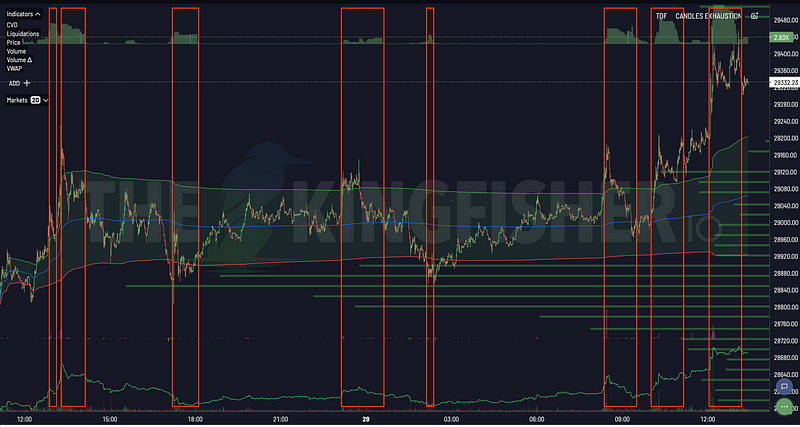
Kingfisher angle: Check LiqMap for major crypto liquidation events before deploying large LP positions. A market-wide cascade can cause temporary de-pegs even in "stable" coins. Deploy after volatility, not during it.
Strategy #2: Volatile Pair Farming with Active Management
Setup: LP in ETH/USDC or similar major pair. But actively manage the position.
The key insight: IL hurts most when you withdraw at extremes. If you can time your exits (pull when the ratio normalizes, not when one asset has mooned), IL is manageable.
How Kingfisher data helps:
- Check OI trends before deploying. Rising OI + rising price = strong trend = IL likely as trending asset keeps going (you're selling the winner). Consider waiting for consolidation.
- Monitor funding rates on perp exchanges for the same pair. Extreme funding = crowded trade = potential reversal incoming = good time to LP (you'll be providing liquidity when everyone needs it).
- Watch ToF levels. Low toxicity = calm market = safer for LP deployment. High toxicity = manipulation active = LPs can get rekt by price moves they didn't expect.
Reality check: This requires active management. Not set-and-forget. If you want truly passive, stick to stablecoin lending.
Strategy #3: Single-Sided Staking/Lending
Setup: Stake $ETH (or provide single-asset liquidity). No IL risk because you're only exposed to one direction.
Options:
- Ethereum beacon chain staking (low single-digit APY as of 2026-10-09)
- Lending protocols (deposit-only mode, earn interest)
- Liquid staking derivatives (Lido, Rocket Pool, earn staking rewards without running a node)
Trade-off: Lower yield than LP farming. Zero IL risk. Your exposure is purely directional (if ETH dumps, your staked ETH is worth less, but you still own the same number of ETH).
For most DeFi participants who aren't full-time degens: This is the right choice. Take the lower yield, avoid the IL headache, spend your time on things that move the needle (like trading with Kingfisher data).
Risk Management: The Stuff That Matters
Smart Contract Risk
Reality: Protocols get hacked. It happens regularly. Harvest Finance ($24M, 2020). bZx ($8M, 2020). Euler ($8M, 2023). The list goes on.
Mitigation:
- Use audited protocols only (multiple audits from reputable firms)
- Check audit status and findings
- Diversify across 2-3 protocols (don't put everything in one basket)
- Accept that some risk always exists, size accordingly
Token Inflation Risk
The trap: Protocol pays you 100% APY in their new token. Token looks valuable. You compound your rewards.
Six months later: Token down 90%. Your "100% APY" was negative in USD terms.
Mitigation:
- Auto-sell reward tokens if the protocol allows it
- Farm in stablecoin pools where rewards are meaningful
- Understand tokenomics before committing capital
- If the reward token looks like garbage, it probably is
Timing Risk (Where Kingfisher Helps Most)
Deploying an LP position at the top of a pump = worst possible entry. You're providing liquidity that will be used by profit-takers exiting long positions. Then price dumps, IL destroys you, and you're left holding bags of a crashing token while earning fees that don't compensate.
Better approach:
- Check LiqMap for the asset you want to farm. Are there clusters nearby? Is price approaching a level where cascades happen?
- Check OI trends. Is this a strong trend (good for directional exposure) or a choppy range (LP paradise)?
- Consider deploying AFTER a flush, not before one. When weak hands have been liquidated and price stabilizes, that's often a good entry for LP positions (you're providing liquidity during recovery, not during chaos).
- Set a mental (or actual) exit trigger. "If token price moves X% from here, I reassess."
What Kingfisher Can and Can't Do For DeFi
What Helps:
- Price/volatility data for IL estimation calculations
- Market cycle context (farm in accumulation phases, take profits in mania phases)
- Liquidation cluster awareness, don't deploy large LP positions when a cascade zone is nearby
- ToF readings, low toxicity = calmer markets = safer for passive strategies
What We Don't Do:
- We don't integrate with DeFi protocols (we're analytics, not a wallet/protocol)
- We don't execute yield farming operations
- We don't provide custody or hold funds
- We don't give financial advice on specific protocol investments
Always DYOR (Do Your Own Research) on any protocol before depositing. Read the smart contract audits. Understand the tokenomics. Check the team. Verify TVL is real and not inflated.
The Hierarchy of DeFi Safety
Tier 1 (Safest): Lending protocols (Aave, Compound) with stablecoins only
- Risk: Platform hack, de-peg
- Return: 3-10%
- Effort: Near-zero after setup
Tier 2 (Moderate): Staking established PoS tokens (ETH, major L1s)
- Risk: Price drop, slashing
- Return: 4-8%
- Effort: Low
Tier 3 (Higher Risk): Stablecoin LP on established DEXs (Curve, Uniswap)
- Risk: IL (small for stable pairs), platform risk
- Return: 5-20%
- Effort: Moderate (need to monitor)
Tier 4 (High Risk): Volatile asset LP farming
- Risk: Significant IL, impermanent loss realization, platform risk
- Return: 20-100%+
- Effort: High (active management required)
Tier 5 (Gambling Disguised As DeFi): New/unaudited protocols, memecoin-adjacent farming, leverage farming
- Risk: Total loss of principal likely
- Return: 100%+ (until it isn't)
- Effort: Variable (usually ends in tears)
Rule: Never put more than you can afford to lose in Tier 4+. Keep majority of capital in Tiers 1-3 unless you're an experienced degen with a track record (and even then, be honest with yourself about your edge).
FAQ
Q: What's a realistic APY range for sustainable DeFi yield farming right now (as of 2026-10-09)? A: It depends on the current incentive cycle, so treat any range as a snapshot. At the time of writing, low-risk stablecoin LP positions (Tier 1-2) have been yielding in the mid single digits to low teens, while established blue-chip DeFi protocols (Uniswap, Aave, Curve) have ranged higher depending on pool and token pairing. Anything advertising very high sustained APY on stablecoins is usually one of: (a) temporary incentive farming that will drop sharply when rewards end, (b) carrying hidden risks (smart contract bugs, oracle manipulation, admin key risk), or (c) a Ponzi. The farms that generate real sustainable returns tend to sit in the boring single-digit to low-double-digit range. If it sounds too good to be true, your principal is the product.
Q: How much can impermanent loss cost me? A: IL formula: roughly equals half the geometric mean of the price divergence. In practical terms: if one asset in your LP pair 2x while the other stays flat, your IL is approximately -5.7%. At 3x divergence: -13.4%. At 5x: -21.5%. At 10x: -42.5%. During the 2021 bull run, ETH/BTC LP providers routinely experienced 30-50% IL despite earning "20% APY" fees, net result was often negative. The trap: IL looks small when prices are stable and compounds brutally during trends. Only provide LP in pairs you're indifferent about the price ratio between, or actively hedge the directional exposure.
Q: Does Kingfisher data help with DeFi yield farming decisions? A: Indirectly but meaningfully. While KF doesn't track DeFi-specific metrics (TVL, protocol revenue, IL calculators), our broader market data provides crucial context: (1) Funding rates tell you whether leveraged longs are paying through the nose (extreme positive funding = crowded longs = potential DeFi token correction incoming). (2) OI trends show whether new money is entering or exiting crypto overall (falling OI across the board = risk-off environment = poor timing for deploying into risky DeFi positions). (3) LiqMaps reveal systemic risk zones. If BTC has a massive long cluster below current price being tested, the entire DeFi ecosystem is at contagion risk. Farm yields when market structure supports risk-on; pull back when it doesn't.
Q: What percentage of my portfolio should I allocate to DeFi yield farming? A: It depends entirely on your risk tolerance and experience level. Complete beginners: 0% until you understand smart contract risk, IL mechanics, and have audited at least one protocol's codebase yourself (or trusted someone who has). Experienced users comfortable with smart contract risk: 10-30% max in Tiers 1-3 (stablecoin LP, blue-chip DeFi, established protocol farming). Degen veterans with multiple cycle experience and ability to absorb total loss: up to 50% with heavy Tier 3-4 concentration. The critical rule: never farm yield with money you cannot afford to lose 100%. Not "lose 20%", lose everything. Smart contract exploits, oracle attacks, and admin key rug pulls result in total loss, not partial drawdowns.
Q: How do I evaluate whether a new DeFi protocol is safe enough to farm on? A: Minimum checklist before depositing a single dollar: (1) Audit. Has the code been audited by a reputable firm (OpenZeppelin, Trail of Bits, Consensys Diligence)? When? Any findings unresolved? (2) Team, are they doxxed (public identities)? What's their track record? Previous projects? (3) TVL, is there meaningful skin in the game from other participants? Under $10M TVL is risky regardless of audits. (4) Tokenomics, is the yield coming from real fees or inflated token emissions? Emission-funded APYs collapse when token price drops. (5) Time in production. Has the protocol survived at least one bear market or major stress event? Protocols younger than 6 months carry exponentially higher risk regardless of other factors.
Bottom Line
DeFi yield farming can generate real returns. People have built life-changing wealth through it. But the people who succeed treat it as active risk management, not passive income. They understand IL. They monitor positions. They take profits. They diversify. They know when to deploy and when to run.
Kingfisher won't farm yield for you. We're not a DeFi protocol. But our market data gives you context that pure DeFi tools lack: where leverage is concentrated in the broader market, when volatility is elevated, whether the "trend" you're seeing is real or manufactured. Combine that with solid DeFi research and proper risk management, and yield farming becomes a viable strategy rather than a casino visit.
Farm responsibly. Check data first. Take profits. Repeat.
Related Articles
Free Account. Market Data for Smarter Decisions, See All Kingfisher Features