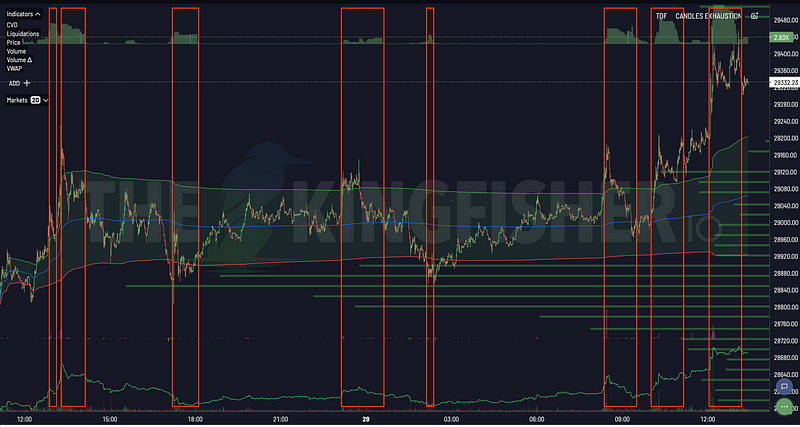


Introduction: Professional Day Trading in Cryptocurrency
Day trading cryptocurrency requires more than just technical analysis. It demands access to institutional-grade data and the ability to interpret complex market dynamics. Professional traders using Kingfisher"s exclusive tools like Liquidation Maps and GEX+ have a significant advantage in identifying profitable intraday opportunities.
What you"ll learn:
- Professional day trading setups
- Liquidation cluster trading strategies
- GEX+ dealer positioning analysis
- Multi-signal confirmation techniques
- Risk management for day trading
- 2026 market-specific strategies
Understanding Market Microstructure
The Foundation of Day Trading
Order Flow Dynamics
- Market orders: Immediate execution, impact price
- Limit orders: Provide liquidity, sit in order book
- Iceberg orders: Hidden large orders
- Stop orders: Trigger market orders on price movement
- Algorithmic orders: Automated execution strategies
Liquidity Pools
- Exchange order books (visible liquidity)
- Hidden liquidity (dark pools, OTC)
- On-chain liquidity (DEX pools)
- Derivatives liquidity (futures, options)
Price Impact
- Large orders move price against desired direction
- Slippage cost varies by exchange and pair
- Understanding liquidity depth is crucial
Why Microstructure Matters
- Retail traders see only order book surface
- Institutions see hidden flows and positioning
- Liquidation cascades create intraday opportunities
- Dealer hedging drives short-term price action
- Market microstructure inefficiencies = profit potential
Core Day Trading Strategies
Strategy 1: Liquidation Cluster Trading
The Setup
Identify Liquidation Clusters:
- Open Kingfisher Liquidation Map
- Look for dense liquidation clusters
- Identify support/resistance zones
- Check cluster strength (dollar value)
- Verify with other signals
Entry Rules:
- Price approaches major liquidation cluster
- GEX+ shows dealer positioning aligned with cluster
- OI (Open Interest) supports the move
- Funding rate is not at extreme levels
- Volume spike precedes the move
Exit Rules:
- Target: Next liquidation cluster level
- Stop: Below/above cluster zone (depending on direction)
- Take partial profits at intermediate levels
- Trail stop as price moves favorably
Example Trade
Scenario:
- Bitcoin at $95,000
- Major liquidation cluster at $96,500 (long liquidations)
- GEX+ shows negative (dealers short)
- OI increasing with price
- Funding: +0.01% (slightly bullish, not extreme)
Trade:
- Enter short at $95,200
- Stop at $96,000 (above cluster)
- Target 1: $94,500 (partial profit)
- Target 2: $93,800 (next support cluster)
- Risk/Reward: 1:2.5
Result:
- Price hits $93,800 within 4 hours
- Full target reached
- 2.5R profit captured
Strategy 2: GEX+ Dealer Positioning
Understanding GEX+
What GEX+ Shows:
- Net gamma exposure of options dealers
- Dealer hedging requirements
- Price "magnet" levels
- Gamma squeeze potential
GEX+ Interpretation:
- Positive GEX+: Dealers long gamma, buy dips, sell rips
- Negative GEX+: Dealers short gamma, sell rallies, buy dips
- Extreme levels: Reversal likely approaching
- Cluster alignment: Strongest signal when liquidation and GEX+ align
Trading Strategy
Positive GEX+ Setup:
- Market sells off into dealer support
- Dealers buy to hedge (positive gamma)
- Price bounces aggressively
- Enter long near support
- Target previous highs or resistance
Negative GEX+ Setup:
- Market rallies into dealer resistance
- Dealers sell to hedge (negative gamma)
- Price rejects and reverses
- Enter short near resistance
- Target previous lows or support
Strategy 3: OI and Funding Analysis
Open Interest (OI) Analysis
OI Trends:
- Rising OI + Rising Price = Strong uptrend
- Rising OI + Falling Price = Strong downtrend
- Falling OI + Rising Price = Weak uptrend (watch for reversal)
- Falling OI + Falling Price = Weak downtrend (watch for reversal)
Price/OI Divergence:
- Price makes new high, OI doesn"t = Bearish divergence
- Price makes new low, OI doesn"t = Bullish divergence
- Divergences often precede reversals
Funding Rate Analysis
Funding Interpretation:
- Positive funding (longs pay shorts): Bullish sentiment
- Negative funding (shorts pay longs): Bearish sentiment
- Extreme funding (>0.05% or <-0.05%): Reversal likely
- Funding flip: Strong trend change signal
Read the full Funding Rate Guide for detailed strategies around carry trades and contrarian fades.
Trading Funding Extremes:
- Funding at extreme positive: Look for short entry
- Funding at extreme negative: Look for long entry
- Combine with liquidation clusters for best results
Multi-Signal Confirmation Framework
The 3+ Signal Approach
Why Multiple Signals Matter
Single Signal Issues:
- False breakouts common
- Fakeouts occur frequently
- Manipulation can trigger single signals
- Low win rate with single signals
Multi-Signal Benefits:
- Confirmation reduces false signals
- Higher win rate (60%+ achievable)
- Better risk/reward ratios
- More consistent profitability
Confirmation Checklist
Before Entry, Verify:
- Liquidation cluster at key level
- GEX+ dealer positioning aligned
- OI trend supports the move
- Funding not at extreme (unless fading)
- Volume spike preceding move
- Price respecting key levels
- If 3+ signals align: High confidence trade
- If only 1-2 signals: Skip or reduce size
Intraday Time Frames
Optimal Trading Hours
US Market Hours (EST)
Market Open (9:30 AM - 11:00 AM):
- High volatility after overnight news
- Institutional flow enters market
- Good for trend following strategies
Lunch Session (11:00 AM - 2:00 PM):
- Lower volatility typically
- Market consolidates
- Range trading strategies work well
Power Hour (2:00 PM - 4:00 PM):
- Increased volatility into close
- Position squaring
- Good for breakout trading
After-Hours (4:00 PM - 8:00 PM):
- Thin liquidity
- Wider spreads
- Increased risk of manipulation
Crypto 24/7 Considerations
Best Times to Day Trade:
- US market open/correlations with equities
- European session overlap (8:00 AM - 11:00 AM EST)
- Asian session evening (US evening hours)
- Major economic releases (FOMC, CPI, NFP)
Avoid:
- Low liquidity weekend trading
- Major holiday periods (reduced volume)
- Exchange maintenance windows
Risk Management
Protecting Your Capital
Position Sizing
Risk Per Trade:
- Maximum 1-2% of account per trade
- Adjust based on confidence level
- Higher confidence (3+ signals): 2%
- Lower confidence (2 signals): 1%
- Single signal: Skip entirely
Stop Loss Placement:
- Below/above liquidation clusters
- Beyond key support/resistance
- At structure breaks (if following trend)
- Maximum risk: 1R (1x risk)
Portfolio Management
Day Trading Portfolio Rules:
- Maximum 3 concurrent positions
- Correlated pairs count as single position
- Keep total portfolio risk under 5%
- Scale in/out of positions
- Take partial profits at targets
Daily Loss Limits:
- Stop trading after 2R daily loss
- Take a break after 3 consecutive losses
- Don"t force trades to "make it back"
- Preserving capital is priority #1
Advanced Techniques
Scaling and Pyramiding
Scaling Into Positions
Partial Entry Strategy:
- Initial entry (50% position) on first signal
- Add 25% if price moves favorably
- Add final 25% on pullback to entry zone
- Move stop to breakeven after second entry
Benefits:
- Reduces entry risk
- Improves average price
- Allows confirmation before full size
- Less emotional stress
Pyramiding Winners
Add to Winning Positions:
- Only add when trade is profitable
- Each addition smaller than previous
- Trail stop with each addition
- Take partial profits at major levels
Example:
- Entry 1: 1.0 lots at $95,000
- Entry 2: 0.5 lots at $95,500 (in profit)
- Entry 3: 0.25 lots at $96,000 (in profit)
- Total position: 1.75 lots
- Average price: $95,285
Common Mistakes to Avoid
Day Trading Pitfalls
Mistake 1: Trading Without a Plan
Problem:
- Entering trades based on hunches
- No defined entry/exit rules
- Emotional decision making
- Random position sizing
Solution:
- Create written trading plan
- Define exact entry rules
- Know exit before entry
- Follow position sizing rules
Mistake 2: Overtrading
Problem:
- Trading too many setups
- Fearing missing out (FOMO)
- Taking low-quality trades
- Burnout and poor decisions
Solution:
- Quality over quantity
- Wait for 3+ signal alignment
- Skip marginal setups
- Focus on best opportunities only
Mistake 3: Ignoring Market Context
Problem:
- Trading in low volatility
- Fighting major trends
- Ignoring correlation markets
- Overlooking news events
Solution:
- Assess market conditions first
- Trade with the trend when strong
- Check equity/correlation markets
- Be aware of scheduled news
Mistake 4: Poor Risk Management
Problem:
- Risking too much per trade
- No stop loss or wide stops
- Moving stops emotionally
- Revenge trading after losses
Solution:
- Fixed 1-2% risk per trade
- Tight stops at key levels
- Set stops and leave them
- Stop trading after daily loss limit
2026 Market Considerations
Evolving Market Dynamics
Institutional Participation
Impact on Day Trading:
- More efficient price discovery
- Reduced intraday volatility (sometimes)
- Larger order flows visible in data
- Need for institutional-grade tools (Kingfisher)
- Algorithms dominate short-term price action
Adaptation Required:
- Use liquidation maps to see institutional footprints
- Monitor GEX+ for dealer positioning
- Trade with institutional flows, not against them
- Expect faster mean reversion
Regulatory Changes
2026 Considerations:
- Increased exchange regulations
- Potential stablecoin legislation
- Tax reporting automation
- Market structure changes
Stay Informed:
- Follow regulatory news
- Understand new reporting requirements
- Adapt strategies to changing structure
- Maintain compliance while trading
Building Your Day Trading System
Step-by-Step Framework
Phase 1: Preparation
Daily Routine:
- Review overnight market action
- Check Kingfisher liquidation maps
- Identify key levels and clusters
- Note economic calendar events
- Plan potential setups for the day
Phase 2: Execution
Trading Process:
- Wait for 3+ signal alignment
- Enter according to plan
- Set stop loss immediately
- Take partial profits at targets
- Trail stop to protect gains
Phase 3: Review
End-of-Day Routine:
- Review all trades taken
- Document what worked/what didn"t
- Calculate day"s P&L
- Plan adjustments if needed
- Prepare for tomorrow
FAQ
Q: How many trades should I aim for per day as a crypto day trader? A: Quality crushes quantity. 1-3 well-selected trades per day is optimal for most day traders. More than 5 and you"re almost certainly lowering standards, overtrading, and paying unnecessary fees. The best day traders on Kingfisher often take ONLY 1-2 trades per day but each has 3+ confirming signals (LiqMap cluster alignment + GEX+ confirmation + OI trend support + normal funding + TOF flow agreement). One excellent setup with full position sizing beats five marginal ones every time. If you can"t find a setup meeting your criteria by mid-session, don"t force it, a day with zero trades is better than a day with three losing ones.
Q: Which timeframe combination works best for crypto day trading in 2026? A: The proven framework: 15-minute chart for trend direction and setup identification, 5-minute for entry precision, 1-minute for timing the exact fill. Use 1H for broader context (is today"s action aligned with the larger trend?) but don"t make entry decisions off it. Avoid anything below 1-minute for decision making. It"s mostly noise and execution lag will kill any edge you think you have. The key insight: higher timeframes tell you WHAT to trade (direction/setup), lower timeframes tell you WHEN to enter. Never flip this hierarchy.
Q: How does Kingfisher"s multi-signal framework improve day trading win rates? A: Our user data shows day traders using 3+ signal confirmation average 58-64% win rates versus 45-52% for single-signal traders. The framework: (1) LiqMap identifies the level (WHERE is the cluster target?). (2) GEX+ confirms dealer regime (will they help or fight my direction?). (3) OI validates trend strength (real buyers or short covering?). (4) Funding rate checks for crowding (am I entering the crowded side?). (5) TOF/CVD confirms flow aggression (is smart money moving my way?). Three+ aligned signals = execute. Two signals = smaller size or wait. One signal = skip. Conflicting signals = no trade. This filter alone eliminates 60-70% of losing trades before they happen.
Q: What"s the realistic income potential for a full-time crypto day trader? A: Let"s be honest about the math. On a $25K account with proper risk management (1% per trade = $250 max risk), targeting 2R winners with a 55% win rate, taking 3 trades/day, 20 days/month: expected monthly return is approximately $1,650-$2,750 (6.6-11% monthly). That"s $20K-$33K annually before taxes, decent supplemental income, not life-changing wealth. To make a full-time living ($5K+/month after taxes) from day trading alone requires either: a larger account ($75K+), a higher win rate (60%+ which takes years to develop), or accepting higher risk (which eventually blows you up). Most successful day traders start part-time and scale up as skills compound over 12-24 months.
Q: What"s the biggest difference between profitable and unprofitable day traders using Kingfisher? A: Consistency in process, not brilliance in picks. Unprofitable day traders check LiqMap sometimes, forget GEX+, ignore funding, and enter based on "feeling" when a setup looks close enough. Profitable ones run the same pre-trade checklist EVERY single time without exception: LiqMap checked? GEX+ regime confirmed? OI supporting? Funding safe? TOF agreeing? Position sized per calculator? Stop set BEFORE entry? The checklist takes 3 minutes. Skipping it costs thousands. The traders who treat day trading like a job with mandatory procedures are the ones still trading profitably a year later. The ones who "wing it" based on gut feeling are the ones funding the profitable ones" returns.
Conclusion: Mastering Day Trading with Kingfisher
Professional Trading Advantages
With Kingfisher, day traders gain:
Key Advantages:
- Liquidation Maps, See hidden institutional levels
- GEX+, Exclusive dealer positioning data
- OI Analysis, Trend confirmation strength
- Funding Rates, Sentiment extremes
- Multi-Signal Framework, 60%+ win rates
Building Consistent Profitability:
- Start with 1-2 strategies, master them
- Use multi-signal confirmation always
- Risk management is non-negotiable
- Review and refine constantly
- Stay patient for best setups
Day trading cryptocurrency in 2026 requires institutional-grade data. Kingfisher provides retail traders with the tools previously reserved for institutions.
Start Your 14-Day Free Trial, Compare Pricing Plans, View All Features
Resources:
- Liquidation Maps Tutorial
- GEX+ Guide
- Trading Community
Related Articles
- The Kingfisher Scalping Toolbox: Complete Guide to Scalping Crypto Perps
- How to Stop Analysis Paralysis and Find Trades Fast
- Swing Trading Crypto Strategies: Complete Guide 2026
- How to Read Crypto Charts: Complete Beginner"s Guide
**Trade Like a Pro -->