

How to Detect Market Manipulation in Real-Time
The Moment You Realize You've Been Played
You enter a long on $ETH. Technicals align. Volume looks good. Momentum is building. This is the one.
Thirty seconds later, price reverses violently. No news. No catalyst. No explanation. Just pure, unadulterated carnage.
Your brain immediately goes to one of two places:
Option A: "I picked the wrong direction. Bad luck. Let me try again." Option B: "Was that real? Or did someone just push price into my stop -- and everyone else's -- and profit from it?"
If you've been trading long enough, you know Option B isn't paranoia. It's experience. Market manipulation in crypto isn't a conspiracy theory. It's a daily operating procedure for anyone with enough capital and data to execute it.
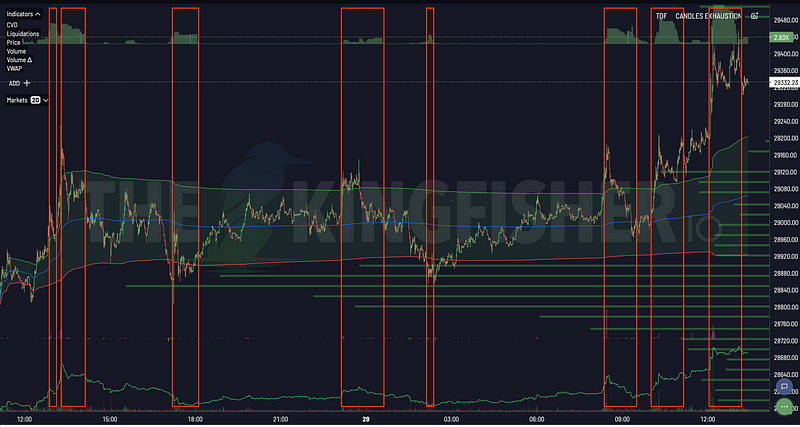
Kingfisher's HFT metrics -- primarily Toxic Order Flow (ToF) combined with Liquidation Map data -- give you the ability to detect this manipulation as it happens, not after your PnL tells the story.
How Manipulation Actually Works (The Mechanics)
The Playbook That Runs Every Day
Step 1: Identify the target zone Whales and algos use sophisticated tools (some of them look a lot like Kingfisher) to identify where retail traders have clustered their stops and liquidation price points. These zones are usually at obvious support and resistance levels -- round numbers, recent swing highs/lows, major moving averages.
Step 2: Push price toward the target Large aggressive orders start moving price toward the cluster zone. On low-volume periods or thin markets, this doesn't take much capital.
Step 3: Trigger the cascade Price hits the first layer of stops. Those stops trigger market sell/buy orders. More price movement. Next layer of stops triggers. Cascade accelerates.
Step 4: Reverse and profit The entity that pushed price in Step 2 now takes the other side of the trade. They bought the panic dip (or sold the panic pump). Price recovers. Retail is rekt. Smart money banks the spread.
This cycle plays out dozens of times per day across dozens of pairs. The only question is whether you're providing the liquidity or profiting from it.
Your Detection Toolkit
Tool #1: Toxic Order Flow (The Lie Detector)
What ToF measures: The proportion of trading volume coming from informed participants vs uninformed participants. Based on VPIN (Volume-synchronized Probability of Informed Trading) -- academic research that proves high VPIN = incoming volatility spike.
How to read it:
| ToF Level | What It Means | Your Action |
|---|---|---|
| 0-30 | Normal market activity | Trade normally |
| 31-60 | Elevated -- something's happening | Tighten stops, reduce size |
| 61-100 | Extreme -- manipulation likely active | Strong caution or counter-trade setup |
Critical detail: The colors in ToF differentiate between exchanges (Bybit vs Binance), NOT toxicity levels. Read the actual percentage value. A bright green bar might mean Binance flow, not "safe."
Tool #2: Liquidation Maps (The Target Identifier)
ToF tells you WHEN manipulation is happening. LiqMap tells you WHERE it's targeting.
The combination workflow:
- Open LiqMap → Identify large clusters near current price
- Watch ToF as price approaches those clusters
- ToF spikes + price approaching cluster = Hunt in progress
- ToF drops after flush = Hunt complete, reversal loading
- Enter counter-trade or confirm original direction based on aftermath
Without LiqMap: You know manipulation is happening but don't know the target. Without ToF: You know where targets are but not whether someone is actively pushing toward them. With both: Complete picture. Edge unlocked.
Tool #3: Cross-Exchange Verification
Manipulation often shows up differently across venues:
- Binance ToF spiking + Bybit ToF normal = Exchange-specific manipulation (Binance being hunted)
- Both spiking together = Market-wide manipulation event
- Perps diverging from spot = Leverage-driven move (different dynamics)
Always check the context before acting.
Real Examples From the Field
Example #1: The Classic $BTC Stop Hunt
Time: 2:15 AM UTC (quiet session -- prime hunting ground) Asset: $BTC/USDT Setup: Price at $42,500, grinding sideways LiqMap reading: Major short cluster at $42,800 ($200M+)
What ToF showed:
- Baseline ToF: 28 (normal)
- 10 minutes before push: ToF climbed to 52 (building)
- During push to $42,900: ToF spiked to 78 (extreme)
- At $42,900 peak: ToF hit 85 (maximum)
What happened:
- Price pushed from $42,500 → $42,900 in 12 minutes (unusual for this time)
- Short cluster at $42,800 got partially triggered ($150M liqs)
- ToF dropped from 85 → 35 in 20 minutes (manipulation phase over)
- Price reversed hard to $43,400+
Three types of traders:
- No tools: Stopped out at $42,800. Thought support broke. Maybe shorted more. Got wrecked on reversal.
- ToF only: Saw manipulation happening, didn't know target. Stayed out (correct but missed the reversal long).
- ToF + LiqMap: Saw hunt forming, knew $42,800 was the target, waited for ToF drop, entered long at $43,000. Took clean ride to $43,400+.
Example #2: The $ETH Fake Breakdown
Time: 10:30 AM UTC (active session) Asset: $ETH/USDT Setup: Price at $2,380, looking bearish LiqMap reading: Long cluster at $2,350 ($180M)
ToF progression:
- Start: 35 (normal)
- Gradual climb over 2 hours: 35 → 48 → 62 (elevated)
- At breakdown: 72 (high but not extreme)
What happened:
- Price dropped $2,380 → $2,340 ("clean breakdown")
- Long cluster partially triggered
- ToF stayed elevated briefly then dropped to 28
- Price reversed to $2,420+
The tell: ToF never hit extreme levels (85+). This was a medium-strength hunt, not a full-blown institutional sweep. The reversal was cleaner because there was less cascade momentum to absorb.
Lesson: Not all manipulations are equal. ToF intensity tells you how much fuel is behind the move. Low-to-moderate ToF hunts = quick reversals. Extreme ToF hunts = violent cascades with extended fallout.
Trading the Manipulation (Advanced)
Once you can reliably detect manipulation, you can transition from victim to participant.
The Counter-Trade Setup
Conditions:
- Major LiqMap cluster identified near price
- ToF rising as price approaches cluster (hunt starting)
- ToF spikes at cluster level (execution phase)
- ToF begins dropping (hunt completing)
- Enter counter-trade in direction of reversal
Risk management (non-negotiable):
- Position size: 25-50% of normal (manipulation trades are inherently higher risk)
- Stop loss: Just beyond the cluster zone
- Take profits quickly: Manipulation moves are fast. Don't be greedy.
- Max risk: 1-2% of account even on "sure" setups
Why smaller size? Because manipulation can persist longer than your margin can survive. ToF might stay elevated for hours while accumulation/distribution happens. You're betting on timing -- and timing bets deserve respect.
When NOT to Trade Manipulation
- ToF extreme (>85) AND still climbing: Too early. Let it play out.
- News-driven moves: Catalysts override normal manipulation patterns. Don't fade an FOMC dump.
- Multiple conflicting signals: If LiqMap says one thing and ToF says another, wait for clarity.
- Emotional state compromised: If you're tilted from a recent loss, your judgment on manipulation detection will be garbage. Walk away.
The Mindset Shift
Before Learning Detection:
- Constant second-guessing ("Is this real?")
- Exiting winners too early (fear of trap)
- Holding losers too long (hope it comes back)
- Feeling like the market is rigged against you personally
After Learning Detection:
- Clear signal system (ToF + LiqMap = yes/no/maybe)
- Confidence to hold through normal volatility (ToF says clean)
- Ability to fade fake moves (ToF + cluster = setup confirmed)
- Understanding that manipulation is systematic and exploitable
The key realization: The market isn't rigged against you specifically. It's structured in a way that rewards informed participants and punishes uninformed ones. Your job is to move from the second group to the first. Kingfisher's tools are the vehicle.
Daily Detection Routine
Pre-Trade (2 minutes)
- Open ToF widget for your primary pair(s)
- Check current toxicity level and trend (rising/falling/stable?)
- Open LiqMap -- note nearest clusters above and below price
- Ask: "Is there a cluster near my planned entry that could make this a trap?"
During Trade (as needed)
- ToF rising? Tighten stops. Something's brewing.
- ToF stable/low? Let the trade work.
- ToF extreme (>80)? Consider exiting. Risk/reward has shifted.
Post-Trade Review (weekly)
- Which manipulated setups did I catch? Miss?
- Did I try to trade manipulation that wasn't there?
- What ToF patterns preceded my best/worst trades?
- Am I getting better at distinguishing real moves from hunts?
FAQ
Q: Is crypto market manipulation actually illegal, or is it just "part of the game"? A: It depends on the type and jurisdiction. Wash trading (trading with yourself to create fake volume), spoofing (placing large orders to move price then canceling), and pump-and-dump schemes (coordinated price manipulation) ARE illegal in most jurisdictions including the US (SEC/CFTC jurisdiction). However, stop hunting (pushing price through known stop-loss clusters), iceberg orders (hiding large order size), and momentum-triggered options hedging are PERFECTLY LEGAL market-making practices that FEEL like manipulation to retail traders. The line: illegal manipulation involves DECEPTION (fake volume, false signals, coordinated fraud). Legal "manipulation" is just smart players using capital and information advantages within the rules. Kingfisher helps you detect BOTH types -- but only the legal kind is actionable as a trading edge (the illegal stuff gets shut down eventually anyway).
Q: What are the telltale signs that a price move is manipulated versus organic? A: The manipulation detection framework uses five signals: (1) TOF spike preceding price move -- informed flow positions BEFORE the move starts (organic moves usually have TOF concurrent with or after price). (2) Volume anomaly -- price moves on significantly above-average or below-normal volume (manipulation needs volume concentration; organic moves distribute volume more evenly). (3) LiqMap cluster proximity -- move originates near or targets a major liquidation cluster (stop hunts aim for cluster zones; organic moves don't "know" where clusters are). (4) Order book imbalance -- one-sided depth appearing then disappearing (spoofing/iceberg signatures). (5) Timing pattern -- moves occurring at low-liquidity times (Asian session Sundays) or around known trigger events (options expiry, funding settlement). Three+ signals coinciding = high confidence manipulation detection.
Q: Can I PROFIT from detecting manipulation, or just avoid losing to it? A: Both. Avoidance: when manipulation detected, DON'T trade in that direction (or reduce size significantly). If TOF shows whale selling into a pump and a cluster sits above, don't long -- you're the exit liquidity. Profit: once you identify manipulation pattern (e.g., recurring stop hunt at a specific cluster level), you can FRONT-RUN the reversal. Example: price approaching $64K long cluster, TOF shows aggressive sell orders building (whales positioning for sweep), you SHORT into the cluster approach (with tight stop above cluster), targeting the cascade aftermath. This is how professional traders consistently profit from manipulation they detect -- they don't fight it, they position for the aftermath.
Q: How reliable is Toxic Order Flow for detecting manipulation in real-time? A: TOF is the single best real-time manipulation detector available to retail traders, with roughly 70-80% precision for significant manipulation events (VPIN > 0.7). It's not perfect -- false positives occur during legitimate institutional rebalancing or news-driven flows that look manipulative but aren't. And sophisticated manipulators can mask their footprint somewhat (splitting orders across multiple venues, using icebergs to hide size). But compared to ANY other retail-available signal, TOF is dramatically superior for manipulation detection because it directly measures ORDER FLOW AGGRESSION -- the one thing all manipulation has in common regardless of technique. If someone is manipulating price, they're doing it with aggressive order flow. TOF sees it.
Q: Does manipulation happen more on certain exchanges or during certain times? A: Yes, measurably so. Exchange patterns: thinner-order-book exchanges show more manipulation per unit of volume (easier to move price with less capital). Time patterns: lowest liquidity = highest manipulation efficiency. Asian session Sunday nights (minimal Western participation, thin books) are notorious for sweeps. Around funding settlement times (00:00, 08:00, 16:00 UTC) see elevated stop-hunting as positions adjust. Options expiry days show gamma-related manipulation as dealers hedge/rebalance. Major news events (CPI, FOMC) create both genuine moves AND manipulation layered on top (harder to distinguish). Practical rule: be extra cautious with positions during known high-manipulation windows. Tighten stops or flatten exposure during Asian Sunday overnight holds.
Bottom Line
Market manipulation in crypto is not a bug -- it's a feature. Whales, market makers, and algorithmic desks operate with information and capital advantages that retail traders lack. They use those advantages daily to extract liquidity from the market.
Your options:
A) Be the liquidity. Provide fuel for their sweeps. Get stopped out, provide exit liquidity, wonder why you keep losing money.
B) See what they're doing. Use ToF to detect when they're hunting. Use LiqMap to know where they're hunting. Position yourself accordingly.
Kingfisher gives you option B. The tools exist. The data is real-time. The edge is available to anyone willing to look at it.
Stop being the victim. Start being the detective.
Detect Manipulation Like a Pro -- Get Started Free — Explore All Kingfisher Features
Related Articles
Przekształć Swoją Strategię Krypto
Wykorzystaj Potęgę Kompleksowej Inteligencji Rynkowej The Kingfisher!

Słownik
Poznaj kluczowe pojęcia i koncepcje z naszego kompleksowego słownika handlu kryptowalutami.
Przeglądaj Słownik →Powiązane artykuły

Options Skew Templates for Perp Traders: Complete Guide to Using Skew Data on Kingfisher
Master options skew data for perpetual futures trading. Learn how to read and use Skew templates on Kingfisher, understand different template types (Basic, Vanilla, Premium), when each template works best, and how to combine skew analysis with LiqMap confirmation for high-probability crypto trading setups.

How to Interpret the Leverage Effect in Crypto Markets
The leverage effect explained: why negative returns create more volatility than positive ones, how chain liquidations work, and what Kingfisher's data tells you about leverage risk.
Toxic Order Flow Bitcoin: Detect Market Manipulation in Real-Time
Stop being exit liquidity. Learn how toxic order flow (TOF) reveals when whales are hunting retail traders. Practical guide with step-by-step interpretation and trading strategies.

Getting Started on The Kingfisher: Stop Being Exit Liquidity
What problem does Kingfisher solve? See how liquidation maps reveal where price will go BEFORE it moves there. Stop getting hunted by whales. Start trading with an edge in 10 minutes.