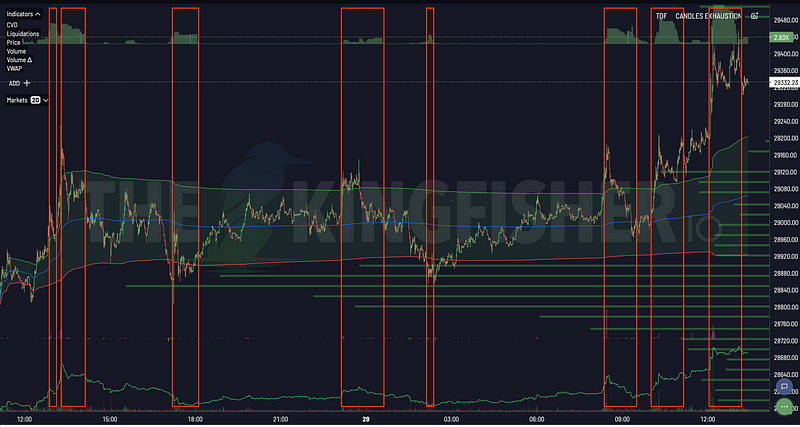


Why Options Skew Matters to Perpetual-Market Analysis
Options skew describes how implied volatility differs across strikes, deltas, or expiries. It can reveal how the options market prices asymmetry: downside protection may be valued differently from upside participation, and near-term event risk may be priced differently from longer-term uncertainty.
That context can be relevant to perpetual futures because options dealers may hedge through spot, futures, or perpetual markets. The relationship is not mechanical in every situation. Public options data does not disclose every dealer’s inventory, hedge, mandate, or execution venue, so skew should not be presented as a direct view of a specific participant’s next trade.
A skew template is best understood as an analytical layout. It places several observations together so that an analyst can compare them consistently. It is not a signal generator and does not establish direction, timing, or expected return. See where forced selling sits right now on the live Ethereum liquidation map. See where forced selling sits right now on the live Solana liquidation map.
Core Concepts Before Opening a Template
Implied Volatility
Implied volatility is an input inferred from option prices. It reflects the volatility level consistent with the market price of an option under a chosen model. It is not a forecast with guaranteed accuracy.
Strike or Delta Skew
Strike skew compares implied volatility across strike prices. Delta skew groups options by sensitivity rather than raw strike. Both can show whether one part of the distribution is priced more richly than another.
Term Structure
Term structure compares implied volatility across expiries. A near-term event can affect the front of the curve without changing longer expiries in the same way.
Gamma and Dealer-Hedging Inference
Gamma describes how an option’s delta changes as the underlying moves. Aggregate gamma estimates can support hypotheses about possible hedging pressure, but the sign and size depend on assumptions about who owns which options. Treat a dealer-positioning estimate as a model, not a disclosed book.
A Layered Way to Read Skew Templates
Template names and account entitlements can change. The framework below refers to analytical layers rather than promising that a particular named layout is available in every account.
| Layer | What it describes | Main caveat |
|---|---|---|
| Price structure | Trend, range, and observed volatility | Historical structure does not predict the next move. |
| Options skew | Relative implied-volatility pricing | Richness can persist and may reflect hedging rather than direction. |
| Term structure | Differences across expiries | Event timing and contract liquidity matter. |
| Liquidation context | Modelled leveraged vulnerability by price | Zones are estimates, not targets. |
| CVD or trade flow | Classified aggressive buying and selling | Venue coverage and classification affect the series. |
| Spot/perpetual basis | Relative pricing between markets | Carry, fees, and execution constraints can explain divergence. |
The value of a template comes from keeping these layers distinct. If two panels disagree, the disagreement should be recorded rather than forced into a bullish or bearish label.
Reading Price and Volatility Context
Moving averages, VWAP, Bollinger Bands, or an Ichimoku display may appear beside skew data. These are summaries of past price and volume. They can help describe whether the current observation occurs inside a range, near a commonly watched reference, or during a change in realized volatility.
Avoid converting those descriptions into certainty. “Price is above VWAP” is an observation. “Price must continue higher” is a prediction that the observation does not support.
Cumulative Liquidation Delta
Cumulative Liquidation Delta (CLD) summarizes classified long and short liquidations over a chosen period. Depending on the implementation, bars or a cumulative line may show which side experienced more recorded forced closures.
CLD can help answer:
- whether recorded liquidation activity was one-sided or balanced;
- whether activity appeared as a brief event or persisted across the window;
- whether price moved with or against the cumulative series;
- whether the result changes when the venue set or timeframe changes.
CLD does not reveal unreported liquidations, prove a support or resistance level, or guarantee exhaustion after a large print.
Buy/Sell Volume and CVD
Buy/sell-volume panels classify trades according to an aggressor rule. CVD accumulates the difference between classified aggressive buys and sells. These measures can be compared with price, but a divergence has several possible explanations: passive absorption, fragmented venue activity, delayed response, hedging, or classification noise.
When documenting a divergence, include the venue set, timeframe, start point, and whether the observation persists. Changing the start point of a cumulative series can change its visual story.
Volume-Extreme Filters
A volume-extreme filter highlights observations that differ from a recent baseline. The baseline, window, and normalization method determine what “extreme” means. A highlighted bar is therefore a statistical description under that configuration, not proof that a reversal or continuation is imminent.
Questions worth recording include:
- What baseline and lookback produced the label?
- Was the event visible on one venue or several?
- Did spread and depth change at the same time?
- Was there scheduled news or expiry flow?
- Does the interpretation survive a different aggregation window?
Exchange-Specific Views
Venue-level panels can reveal that activity is not uniform across exchanges. A difference may reflect user mix, contract design, quote currency, liquidity, or temporary data coverage. It should not automatically be labelled “smart money” on one venue and “retail” on another.
For reproducibility, identify the contract and quote convention before comparing two exchanges. Apparent divergence can come from comparing instruments that are not economically identical.
Spot, Futures, and Perpetual Comparisons
A relative-price or basis panel compares related markets. A premium or discount can reflect funding expectations, carry, demand for leverage, collateral constraints, or execution frictions. It does not by itself show which market is “correct.”
Likewise, differences between spot CVD and perpetual CVD may be informative but are not a deterministic direction signal. The two markets can serve different participants and hedging needs.
Comparing Skew Context With a Liquidation Map
Options skew and a liquidation map describe different modelled risks:
- skew describes relative option pricing;
- term structure describes how that pricing varies by expiry;
- a liquidation map estimates where leveraged positions may become vulnerable;
- CVD and volume panels describe classified executed flow.
A useful comparison asks whether the observations are mutually consistent and what evidence would disprove the interpretation. It does not turn a modelled zone into a destination.
Hypothetical Observation Record
Downside options are priced more richly than comparable upside options in this snapshot. A modelled liquidation zone is also visible below the market. Executed-flow panels are mixed. The combined evidence describes demand for protection and possible leveraged vulnerability, but it does not establish that price will fall or reach the zone.
This note distinguishes observation from conclusion and makes room for later evidence.
Choosing a Template Layout
The most useful layout is the one whose components you can define and audit. A compact layout may be appropriate for orientation; a venue-specific layout may be appropriate when comparing market structure; an options-focused layout may be appropriate when studying skew and term structure.
More panels do not automatically create better analysis. Adding correlated indicators can make the same underlying event appear to be several independent confirmations.
A Reproducible Review Checklist
For each saved observation, record:
- instrument, expiry, strike or delta convention;
- exchanges and contracts included;
- exact timestamp and aggregation window;
- definitions of every plotted series;
- the initial hypothesis in conditional language;
- at least one plausible alternative explanation;
- the event that would invalidate the hypothesis;
- the later outcome without rewriting the original note.
This makes the analysis auditable and reduces hindsight bias.
Common Mistakes
Treating Skew as a Directional Vote
Rich downside volatility can reflect protection demand, inventory, or event risk. It does not mean price must decline.
Inferring Dealer Inventory From Public Data Alone
Aggregate open interest and option prices do not disclose who is long or short each contract. Dealer-exposure charts depend on stated assumptions.
Mixing Expiries
Near-term and long-dated options can price different risks. Combining them without distinction can hide the event being analysed.
Ignoring Liquidity
Sparse strikes and wide quotes can produce unstable implied-volatility estimates. A visually sharp change may be a data-quality issue.
Selecting Only Successful Screenshots
A few examples cannot establish predictive performance. A valid study defines its sample and method before observing outcomes.
FAQ
Does skew predict whether Bitcoin or Ethereum will rise or fall?
No. Skew describes relative option pricing. It can support a risk hypothesis, but it does not guarantee direction or timing.
Is a skew template useful if I do not trade options?
It can provide context about how options are priced, provided its assumptions and limitations are understood. It should remain separate from an execution decision.
What is the difference between skew and realized volatility?
Skew compares implied volatility across parts of the option surface. Realized volatility measures variation in historical returns. They answer different questions.
Can CVD confirm an options-skew interpretation?
CVD can show whether classified aggressive flow is consistent with a hypothesis. It cannot prove why participants traded or validate the hypothesis by itself.
Where can I verify current template access and pricing?
Names, availability, entitlements, and prices may change. Check the authenticated Kingfisher app for current information.