
The Asymmetric Reality of Leverage
Here's a simple truth that most crypto traders learn the hard way:
Negative returns hurt more than positive returns help.
This isn't philosophical. It's mathematical. It's called the leverage effect, and in crypto perp markets, where venues advertise leverage caps in the triple digits on some pairs, the concept moves real money. It's the reason accounts vanish in single cascades.
The leverage effect states that negative returns have a disproportionately larger impact on volatility than positive returns of the same magnitude. When prices drop, leveraged positions get force-sold, which drives prices lower, which forces MORE positions to liquidate, which drives prices even lower.
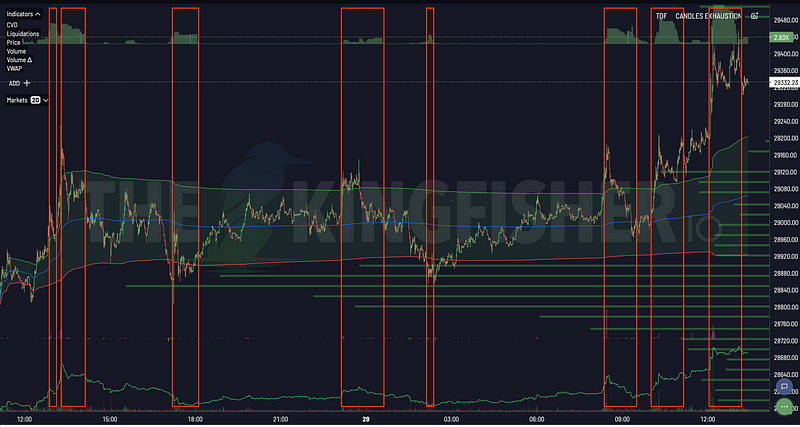
In crypto, this feedback loop is visible in real-time on Kingfisher's Liquidation Maps. You don't need to theorize about it. You can watch it happen.
What the Leverage Effect Is
The Academic Definition
The leverage effect (first documented by Black in 1976) describes a phenomenon where a firm's financial leverage increases as its stock price declines. Lower equity value relative to debt = higher effective leverage = higher volatility of returns going forward.
In traditional markets: A company's stock drops → its debt-to-equity ratio worsens → perceived risk increases → volatility rises → potentially more price decline (vicious cycle).
In crypto markets: The same dynamic plays out across millions of individual traders simultaneously, and it happens in minutes, not quarters.

The Crypto Perp Version: Chain Liquidation

An example of a high leverage tier offered on some venues
Crypto exchanges offer leverage that would make a traditional risk manager cry. Caps vary by exchange and change over time; here is a snapshot as of 2026-10-09:
- Binance: up to 125x on some pairs
- Bybit: up to 100x
- dYdX: up to 20x
When $BTC drops 10% and you're leveraged 20x:
- Your effective margin drops much more than 10%
- If your position approaches liquidation price, exchange closes it
- That forced selling adds to downward pressure
- Other highly-leveraged longs get closer to their own liq prices
- More forced selling
- Cascade
This IS the leverage effect in action. Each liquidation begets more liquidations. The initial price drop is amplified by the structure of leveraged markets themselves.
Real-world example: March 12, 2020. $BTC dropped ~50% in 24 hours. The leverage effect didn't just contribute to that drop. It ACCELERATED it. Every round of liquidations fueled the next. By the time it was over, countless traders had been wiped out because their leverage made them unable to survive a move that, in spot terms, was severe but survivable for unleveraged holders.
How to Use Leverage Effect Data in Your Trading
Reading the Signs
Sign #1: Rising OI during a drop = Leverage effect loading
If $BTC is falling but Open Interest is INCREasing, new shorts are entering (or new longs are getting trapped). Either way, leverage in the system is growing while price drops. That's the leverage effect building potential energy for a violent move, in either direction depending on who's winning.
Sign #2: Extreme funding rates = Crowded leverage
When funding hits +0.05% or -0.05%, one side is paying to hold their leverage. That crowded trade is a coiled spring. When it releases, the leverage effect kicks in hard.
Sign #3: LiqMap clusters expanding = Fuel stacking
Watch the Liquidation Map over time. Are clusters at key levels getting TALLER (more capital concentrated)? That's leverage accumulating at specific prices. The leverage effect says: when those levels get tested, the reaction will be disproportionate to the initial catalyst.
What Kingfisher Tells You That Raw Price Doesn't
Price alone: "$BTC dropped 3% today." Information: Minimal.
Price + OI: "$BTC dropped 3%, OI rose 8%." Information: New shorts entered aggressively. Leverage building. Potential cascade if drop continues.
Price + OI + Funding: "$BTC dropped 3%, OI up 8%, funding went from +0.01% to +0.04%." Information: Longs are stressed and paying heavily. Crowd is wrong-footed. Leverage effect loading toward long liquidation.
Price + OI + Funding + LiqMap: All of the above PLUS "$400M long cluster sitting at $64,500, right below current price." Information: Complete picture. The leverage effect has a specific target. When price hits $64,500, those longs cascade, and the leverage effect amplifies the move through $64K toward the next cluster or support level.
That last layer, the LiqMap context, is what separates guessing from analysis. Kingfisher Success Stories: How Traders Actually Use the Data walks through this in more detail.
Practical Implications for Traders
Implication #1: Size for the Worst Case (Leverage Effect Included)
Most position size calculators tell you "risk 2% per trade." That assumes normal market conditions.
During periods of elevated leverage effect (high OI, extreme funding, large nearby clusters), the "normal" 2% loss can become a 5-8% loss because cascading widens spreads and creates gaps.
Adjustment: During high-leverage-effect environments, cut your normal position size in half. Not forever, just until the leverage concentration dissipates.
Implication #2: Cross-Margin Is a Leverage Effect Multiplier
Cross-margin trading links all your positions together. One position getting liquidated reduces your account balance, which brings every OTHER position closer to its liquidation price.
This is the leverage effect on steroids. Your $ETH long doesn't need to drop much if your $SOL long already got liq'd and halved your balance. The effective leverage of your remaining position just doubled because your collateral base shrank.
Rule: If you must use cross-margin (and many exchanges default to it), treat your entire portfolio's effective leverage as what matters, not individual position leverage. A portfolio of five 5x positions in cross-margin might have 25x effective leverage when correlations align against you.
Implication #3: Volatility Clustering Is Real
The leverage effect explains why volatility clusters in crypto. Big moves tend to come in bunches. Why? Because the first big move triggers leveraged liquidations, which amplify the move, which triggers more liquidations. The system stores up leverage during calm periods and releases it violently during stress periods.
Trading implication: After a major cascade event (like a $3K $BTC drop), don't assume "it's over." The leverage effect may have released OR it may have reloaded on the other side (now there are trapped shorts who will get squeezed). Check ToF. Check OI. Check whether clusters have formed on the other side. The post-cascade environment is often where the BEST trades happen, but only if you understand what just occurred.
The Leverage Effect and Market Regimes
Bull Markets: Positive Leverage Effect (Sort Of)
In strong uptowns, the leverage effect works in bulls' favor, sort of. Rising prices force short liquidations, which creates buying pressure, which pushes price higher, which forces more short liquidations. This is the "short squeeze" dynamic, and it's the leverage effect running in reverse.
BUT: This builds massive short clusters above price over time. When the trend finally breaks, those clusters become fuel for a violent downside move amplified by the (now negative) leverage effect. The higher the climb, the harder the fall, because more leverage accumulated at higher prices.
Lesson: Enjoy the squeeze, but watch the LiqMap for growing short clusters above price. Those are the seeds of your future pain if you're still long when the music stops.
Bear Markets / Crashes: Negative Leverage Effect at Maximum
This is where the leverage effect is most destructive. Falling prices → long liquidations → more selling → lower prices → more liquidations. Each round removes participants (their accounts are blown) but also concentrates the remaining positions into fewer, stronger hands.
The survivors of a full leverage-effect crash often have the best opportunities. Because they have capital left when everyone else has been washed out, and assets are trading at extreme discounts. But identifying that moment requires data, not hope.
What Kingfisher Does With This Information
Kingfisher doesn't prevent the leverage effect. That's a market structural feature, not a bug. But it gives you visibility into every component:
- Liquidation Maps: See where leveraged positions are clustered (the targets)
- OI Tracking: Watch leverage accumulate or dissipate in real-time
- Funding Rates: Measure how crowded and stressed each side is
- ToF (Toxic Order Flow): Detect when informed traders are positioning for (or against) the leverage effect
- GEX+: Understand how options dealers' hedging will amplify or dampen leverage-driven moves
The goal isn't to eliminate risk. That's impossible in leveraged markets. The goal is to SEE risk clearly enough to make calculated decisions about when to embrace it and when to step aside. For a fuller treatment, The Kingfisher Scalping Toolbox: A Framework for Crypto Perp Analysis covers the whole workflow.
Quick Reference
| Signal | Leverage Effect Status | Action |
|---|---|---|
| OI rising + price falling | Loading (dangerous) | Reduce size or flat |
| OI falling + price falling | Releasing (flushing) | Watch for bounce entry |
| Funding extreme (+/-) | Crowded (coiled) | Counter-trade candidate |
| LiqMap clusters growing near price | Fuel stacking | Avoid entries near clusters |
| ToF spiking | Informed activity | Tighten stops or wait |
| Multiple signals aligned | Maximum effect | Either best trade or most dangerous, pick your side |
FAQ
Q: What exactly is "the leverage effect" in simple terms? A: It's the amplification of price moves caused by concentrated leveraged positions. When thousands of traders use 10x-50x leverage and all position on the same side of a key price level, any move toward their liquidation prices forces automated position closures (liquidations). Those forced sales/purchases create cascading price movement that amplifies the original move. A 1% price drop triggering $2B in long liquidations can become a 3-4% drop as those liquidations add selling pressure. That multiplication IS the leverage effect. It's why crypto moves 5-10% in hours while stock indices move 1-2% in days. Leverage is the volatility engine.
Q: How can I SEE the leverage effect happening in real-time on Kingfisher? A: Watch these four signals simultaneously during volatile periods: (1) LiqMap clusters shrinking/disappearing near current price = positions being liquidated (fuel burning). (2) TOF spiking aggressively = informed participants reacting to (or causing) the cascade. (3) OI dropping rapidly alongside price = leveraged positions being flushed en masse (not just spot selling). (4) Funding rate spiking in the direction of the move = late arrivals getting caught on the wrong side. When you see all four within a 15-minute window, you're watching the leverage effect in real-time. Price isn't moving because of "sentiment". It's moving because billions in leveraged positions are being force-closed.
Q: Should I trade WITH the leverage effect or AGAINST it? A: Both, depending on context. Trading WITH it (momentum/cascade riding): enter in the direction of the cascade AFTER it initiates (ToF confirms, OI dropping with price, cluster being consumed), target the NEXT cluster on that side. This is catching falling knives by waiting for them to hit the floor first. Trading AGAINST it (contrarian fade): wait for the leverage effect to EXHAUST (OI flush complete, funding extreme, ToF neutralizing), then enter opposite the cascade at a major remaining cluster. The danger: fading too early (cascade has more room) kills more accounts than riding too late. Rule of thumb: ride the first 60% of a leverage-driven move, fade the last 20% when exhaustion signals appear.
Q: How does the leverage effect differ between bull and bear markets? A: Directionally similar but asymmetric in intensity. Bear markets: Leverage effect is MORE violent on the downside. Long liquidations create forced selling which creates more long liquidations (downward spiral). Short covering provides occasional violent bounces but the dominant cascade direction is down. Bull markets: Upward cascades happen (short squeezes) but are typically shorter-lived because: (a) fewer shorts than longs in crypto (structural long bias), (b) profit-taking naturally slows upward moves, (c) longs don't have the same forced-exit mechanism (they CAN hold through volatility unless overleveraged). Practical implication: downside leverage cascades travel further and faster than upside ones. Size short positions accordingly.
Q: What's the relationship between the leverage effect and GEX+ (gamma exposure)? A: They interact powerfully. GEX+ tells you how DEALERS will respond to leverage-driven moves. Positive GEX near a leverage cluster = dealers will BUY dips (absorbing some cascade pressure, potentially creating a bounce point). Negative GEX near a cluster = dealers will AMPLIFY the cascade (selling into weakness, making the leverage effect worse). Zero GEX near a cluster = maximum uncertainty (could be violent either direction). The highest-probability trades align leverage effect direction with GEX response: cascade starting + positive GEX below = dealers will catch the fall (bounce candidate). Cascade starting + negative GEX above = dealers will fuel the rise (squeeze candidate). Mismatched signals = skip or minimum size.
Bottom Line
The leverage effect isn't a theory you need to believe in. It's a mechanical reality of leveraged markets that you can WATCH happen on Kingfisher's tools. Every time a cascade rips through $BTC or $ETH liquidation clusters, you're seeing the leverage effect in action.
Your job isn't to prevent it. Your job is to:
- See it coming (ToF rising, OI shifting, clusters forming)
- Size appropriately (smaller when leverage is concentrated)
- Position yourself correctly (provide liquidity before cascades, buy the flush after)
- Survive to trade another day
Leverage is the engine of crypto's volatility. The LiqMap is your window into that engine. Don't stare at the dashboard, read it.
Track Leverage Risk in Real-Time, View Kingfisher Features