

Funding Rate Calculator & Complete Guide to Crypto Perpetuals
The Math That Prints (Or Costs) Money Every 8 Hours
Perpetual futures are the engine room of crypto derivatives. They never expire, they trade 24/7, and they account for the majority of crypto trading volume.
The mechanism that keeps them anchored to spot price? Funding rates -- periodic payments between longs and shorts that happen like clockwork every 8 hours.
Most traders have a vague idea that "funding exists." Few can tell you exactly what they're paying or collecting on their open positions right now. That's money left on the table.
Let's fix that.
How Funding Actually Works
The Mechanism
Perp price above spot? Longs are "wrong" directionally, so they pay shorts to compensate. Perp below spot? Shorts pay longs. Simple as that.
The formula (simplified):
Funding Rate = (Mark Price - Index Price) / Index Price
Every exchange uses a slightly different implementation -- Binance adds a cliff component, dYdX uses hourly cycles instead of 8-hour -- but the principle is identical across all venues.
Key detail: Exchanges cap funding rates (usually around +/-0.75% to +/-1.5%) to prevent extreme payments from wrecking accounts in a single cycle. Kingfisher shows you both the capped rate (what you'll actually pay/receive) and the uncapped true market pressure (what the crowd really wants).
Calculating Your Funding Payment
The Formula
Funding Payment = Position Size x Funding Rate x (Hours Held / 8)
Real example:
- Position: $10,000 long on $BTC perpetual
- Current funding: +0.01% per 8h (positive = longs pay)
- Time held since last funding: 4 hours
Payment = $10,000 x 0.0001 x (4/8) = $0.50
You pay 50 cents for holding that position for 4 hours. Small on one cycle. But over a month of active trading with multiple positions? It adds up fast.
Another example (the expensive one):
- Position: $10,000 long
- Funding: +0.05% per 8h (extreme positive)
- Holding for 5 days = 15 funding cycles
Payment = $10,000 x 0.0005 x 15 = $75
That's $75 gone to funding alone before you even consider whether the trade was profitable. On a position that might only make $200. Now your net is $125 instead of $200. Funding just ate 37.5% of your profit.
The Carry Trade: Earning Passive Income from Funding
This is where funding analysis goes from defensive to offensive.
Setup:
- Buy 1 $BTC on spot (no funding exposure)
- Short 1 $BTC on perpetual futures
- Collect funding payments every 8 hours
- Delta-neutral -- no directional risk if sized correctly
The math:
- Stable funding: +0.02% per 8h
- Cycles per day: 3
- Daily return: 0.06%
- Annualized: ~21.9%
That's not a typo. Twenty-one point nine percent annualized for collecting the spread between spot and perp pricing. In a flat or ranging market.
Where this breaks down:
- If price moves significantly in either direction, one leg of your hedge loses while the other gains less (basis risk)
- If funding flips negative, you're now paying on the short side
- Requires capital on both sides of the trade (capital efficiency hit)
Best markets for carry: Sideways/ranging markets with stable positive funding. Worst markets: Strong trends (basis widens against you) or high volatility (one leg gets liquidated).
Kingfisher's Funding & OI tool shows annualized yields across exchanges so you can find the best rates and calculate expected returns instantly.
Cross-Exchange Arbitrage: Finding Free Money
Funding rates are rarely identical across exchanges at any given moment:
| Exchange | $BTC Funding | Notes |
|---|---|---|
| Binance | +0.03% | Largest liquidity |
| Bybit | +0.05% | Retail-heavy, often higher |
| OKX | +0.01% | Sometimes lower |
| dYdX | -0.01% | Can go negative when others don't |
The play: Short on the exchange with highest funding (collect most), long on exchange with lowest funding (pay least), neutralize your delta exposure.
Profit: The funding differential. Risk: Exchange-specific liquidation, basis shifts, execution costs.
Reality check: This requires accounts on multiple venues, capital on each side, and active management. Better suited for systematic approaches than manual trading. But the edge is real if you can capture it efficiently.
Funding by Market Phase
Bull Markets: The Long's Burden
Bull markets consistently show positive funding. Longs are willing to pay to be exposed. Rates can reach extreme levels (+0.15%+ per 8h during mania phases).
Strategy: Consider delta-neutral carry (short perp + hold spot). Or at minimum, be aware that your long positions are bleeding funding every cycle. Size accordingly.
What kills bull markets: Not price drops necessarily -- it's funding becoming so extreme that longs can't afford to hold anymore. The forced unwind is brutal.
Bear Markets: The Short's Pain
Bear markets flip funding negative frequently. Shorts pay longs. Often deeply (-0.04% to -0.08%).
Strategy: This is where you collect funding on long perp positions. You get paid to wait for the bounce. When the squeeze finally triggers, you're already positioned and have collected income for days or weeks of patience.
Historical note: Some of the best risk-adjusted returns in crypto come from being long perps during deeply negative funding periods in bear markets. You collect funding while waiting, then catch the squeeze upside. Asymmetric payoff if you survive the drawdown.
Range-Bound: The Grinder's Paradise
Sideways markets oscillate around zero funding or small +/- readings. No free money from carry trades. Funding doesn't give you an edge here.
Strategy: Trade the range using other tools (LiqMap clusters, GEX+ regime). Funding is neutral -- ignore it for direction, use it only to confirm you're not missing an extreme crowding signal.
Using Kingfisher's Funding Tools
What You Get
Funding & OI Widget:
- Real-time funding rates across all major exchanges
- Historical funding charts (see the narrative over time)
- Annualized yield calculator (instantly see what a carry trade pays)
- OI overlay (confirm funding with actual leverage data)
- ML-powered funding predictions (Elite tier -- anticipates next rate)
Alerts:
- Set custom thresholds ("notify me when $BTC funding exceeds +0.05%")
- Get notified before the cycle hits so you can adjust positions
- Email/push/SMS delivery
Calculator:
- Input your position size, direction, and entry time
- See exact payment/receipt down to the cent
- Project daily/weekly/monthly funding cash flow
Common Mistakes
Mistake 1: Checking funding once a week and forgetting it.
Funding changes every 8 hours. A reading from Tuesday means nothing by Thursday. Check it at minimum before opening/closing positions, ideally set alerts.
Mistake 2: Trading the absolute level without context.
+0.04% funding might be extreme for $BTC (normal is +/- 0.01%) but normal for a volatile altcoin. Always compare to the asset's typical range, not some universal threshold.
Mistake 3: Forgetting that funding is a lagging indicator, not a leading one.
Funding reflects positioning that ALREADY EXISTS. Extreme funding tells you the crowd is already positioned -- it doesn't tell you when new money will enter or exit. Use TOF/CVD and LiqMap for timing confirmation.
Quick Reference: Funding Levels
| Level | $BTC | $ETH | Alts | Interpretation |
|---|---|---|---|---|
| Normal | +/-0.01-0.03% | +/-0.01-0.05% | +/-0.02-0.10% | Business as usual |
| Elevated | +/-0.03-0.05% | +/-0.05-0.08% | +/-0.10-0.20% | Getting crowded |
| Extreme | >+/=0.05% | >+/=0.08% | >+/=0.20% | Squeeze loading / Top risk |
FAQ
Q: What's the exact formula for calculating my funding payment per cycle?
A: Funding Payment = Position Size x Funding Rate. The funding rate is applied to your notional position value, not your margin. Example: $30,000 position (not margin -- total position size) at +0.02% funding rate = $30,000 x 0.0002 = $6.00 per 8-hour cycle. Over one day (3 cycles): $18. Over 30 days: $540. On a $6,000 margin at 5x leverage, that's 9% of your margin consumed by funding in a single month -- before any price P&L. Kingfisher's calculator computes this automatically including annualized projections so you can see the true carrying cost at a glance.
Q: What annualized return can I expect from a properly managed carry trade? A: Realistic sustained range of 10-25% annualized net of fees and rebalancing costs, depending on market conditions. During normal BTC funding environments (+0.01-0.03% per 8h), a spot-long/perp-short delta-neutral position yields roughly 9-22% annualized. During elevated periods (bull market peaks, post-ETF launches), yields can briefly spike to 30-50%. During bear markets or risk-off periods, funding can flip negative, reducing or reversing the carry. The key variable most traders underestimate: rebalancing costs and slippage from maintaining the hedge eat 2-5% of gross returns. Factor that in.
Q: How do I calculate whether a trade is worth the funding cost? A: Simple test: divide your expected profit by your expected funding cost over the hold period. If targeting a 4% gain on a leveraged position held for 7 days, and funding will cost 0.5% of margin over that period, your funding-to-profit ratio is 1:8 (acceptable). If funding costs 1.5% of margin against a 3% target gain, ratio is 1:2 (marginal -- consider shortening hold time or skipping). If funding exceeds 30% of expected profit, the trade isn't worth carrying unless you have high conviction on timing. Kingfisher's calculator shows this ratio automatically.
Q: Does funding rate differ significantly between exchanges, and should I care? A: Yes, and it matters if you're trading on a specific venue. Binance, Bybit, and OKX often show different rates for the same asset due to different user demographics and positioning. A 0.02% spread between exchanges on a $50K position held for 30 days = $300 difference in funding costs/rewards. For carry trades specifically, exchange selection is part of the edge. For directional trades, check YOUR exchange's rate since that's what you'll pay/collect. Kingfisher shows aggregate average plus individual exchange breakdowns.
Q: What's the single most important funding calculation rule? A: Never enter a leveraged position without knowing your annualized funding burn rate. Period. Before EVERY trade exceeding 24 hours: open Kingfisher's Funding & OI tool, note the current rate, multiply by your position size x number of cycles you plan to hold, and decide if the cost fits within your R:R framework. This 30-second habit prevents the slow bleed that kills more positions than sudden price moves. Traders who track funding religiously rarely get caught in positions where funding consumed their entire expected profit before price even moved.
Bottom Line
Funding rates are the cost of having an opinion in perp markets. They're also a window into how crowded each side has become. Extreme readings are among the most reliable contrarian signals in crypto -- not because they always work perfectly, but because when they fail, the damage is usually contained (you were already positioned against the crowd).
Track your funding. Calculate your costs. And when funding goes extreme in one direction, start looking the other way. The crowd is usually wrong at extremes -- and funding is their honest confession.
Access Free Funding Tracker | Learn Open Interest | GEX+ Guide** | View Kingfisher Plans
Related Articles
转变您的加密货币策略
利用The Kingfisher的综合市场情报力量!

相关文章

Skew 模板的解析与使用指南
全面解析Kingfisher平台上的Skew分析模板使用方法,为加密货币交易者提供市场关键数据的清晰视图,帮助快速识别最具盈利潜力的交易机会和风险信号。
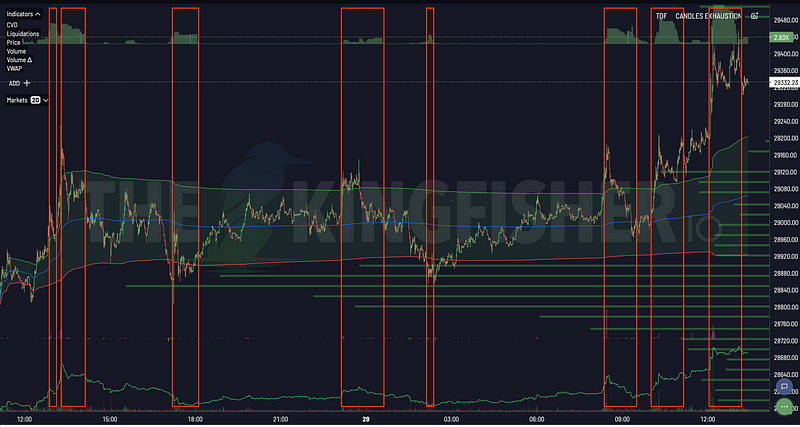
比特币有毒订单流(TOF)分析
深入解析比特币有毒订单流(TOF)检测机制,了解如何利用Kingfisher平台的知情交易数据和清算地图识别流动性真空区域,提前预判潜在价格波动方向,提升交易决策质量。
Kingfisher平台完整入门指南:从注册到第一笔专业分析
详细的Kingfisher平台使用教程,涵盖账户注册、清算地图使用、积分系统、推荐计划以及Pro和Elite版本的功能对比。

利率如何影响加密货币期权定价:交易者完整指南
深入了解利率对加密货币期权定价的影响机制,以及衍生品交易者如何在Kingfisher平台上利用GEX+工具分析期权市场。