

What is GEX? Gamma Exposure Explained for Crypto Traders
The Invisible Hand That Moves Price
You've been there. $BTC rips $3K in an hour for no reason you can find on the chart. Or it gets glued to a level like someone superglued it there. No support line explains it. No resistance makes sense.
That's not "market magic." That's gamma exposure.
Options dealers are hedging their books, and their hedging moves price. Period. The question is whether you can see it coming or not.
GEX (Gamma Exposure) measures exactly that -- where options dealers are positioned and where they're forced to buy or sell as price moves. Understanding gamma is the difference between getting swept by a move you didn't see coming and positioning before the sweep happens.
Let's break down what GEX actually is, why it matters in crypto, and how GEX+ on Kingfisher gives you visibility into what was once institutional-only data.
What is GEX? The Mechanics
Gamma in Plain English
When a trader buys a call option, someone sells it to them. That "someone" is typically a market maker or dealer. The dealer doesn't want directional exposure -- they make money on the spread, not on betting on price. So they hedge.
Here's the chain:
- Trader buys a BTC call option
- Dealer sells the call (now short calls = short gamma)
- Dealer buys BTC spot/futures to hedge delta exposure
- Price goes up -- dealer's short gamma position means they need to buy more BTC to stay hedged
- Price goes down -- dealer needs to sell to reduce exposure
Gamma itself is just the rate at which that delta changes. High gamma means dealers are forced to chase price aggressively. Low gamma means they can sit tight.
GEX aggregates this across every strike price on every active option contract. It tells you the total gamma exposure dealers are carrying and, critically, which side of the market they'll be forced to defend or accelerate.
Positive vs Negative GEX: The Two Regimes
This is where trading decisions get made.
Positive GEX -- Dealers Buy Dips, Sell Rips
When GEX is positive around current price:
- Price drops → dealers must buy to hedge → creates a floor
- Price rises → dealers must sell to hedge → creates a ceiling
- Result: Range-bound, suppressed volatility
Think of positive GEX as shock absorbers. Dealers absorb both directions. Breakouts fail. Fakeouts everywhere. This is where range traders thrive and momentum traders get chopped up.
Real example: $ETH spent three weeks grinding between $3,000-$3,500 with strongly positive GEX across the entire range. Every breakout attempt got rejected within hours. Dealers were defending both sides. If you were buying breakouts during that window, you were donating liquidity.
Negative GEX -- Dealers Accelerate Everything
When GEX flips negative:
- Price rises → dealers must buy more (chasing upside) → positive feedback loop
- Price drops → dealers must sell more (chasing downside) → cascade risk
- Result: Explosive, trending moves
Negative GEX removes the shock absorbers. Now dealer hedging amplifies every move instead of dampening it. This is where squeezes happen. This is where $BTC tags $2K moves in four hours.
Real example: March 2024 -- GEX flipped negative at $65,000 on $BTC. The LiqMap showed $800M in short liquidations stacked at $68,000. Price approached, dealers started chasing, shorts got swept, and $BTC ripped through $70,000 in under two hours. Negative GEX + liquidation cluster = rocket fuel.
The Gamma Flip: Where Regimes Change
The most important single concept in GEX analysis: the flip level.
The flip level is the exact price where GEX transitions from positive to negative (or vice versa). When price crosses it, the entire market regime changes in real time.
- Above flip (negative GEX): Momentum rules. Trend-following strategies.
- Below flip (positive GEX): Range rules. Mean-reversion strategies.
The flip isn't a guarantee -- nothing is. But it tells you what environment you're fishing in. You don't use a bass lure when you're hunting marlin. Same principle.
GEX+ on Kingfisher marks the flip level directly on your chart. You see it before price gets there. That's the edge.
Why Most Free GEX Data Is Trash
Let's be direct about this. The free GEX calculators floating around crypto Twitter?
~60% of them are materially inaccurate. Here's why:
- Incomplete data -- They miss major options venues or aggregate incorrectly
- Delayed updates -- 15+ minute delays in a market that moves in seconds
- Wrong assumptions -- Bad delta calculations, missing expiration cycles, ignoring vanna/charm effects
- No strike-level detail -- Aggregate numbers hide where the actual flips happen
Trading off bad GEX data is worse than trading off no GEX data. At least with no data, you know you're blind. With wrong data, you think you can see -- and that's how you get run over.
GEX+ by Kingfisher: The Real Thing
GEX+ is built differently:
- 100% exchange-aggregated data -- All major options venues, no gaps
- Sub-second updates -- Not 15-minute delayed snapshots
- Strike-level granularity -- See exactly where each flip zone lives
- Historical tracking -- Watch GEX profiles evolve over time (Elite)
- Liquidation map overlay -- See GEX + liq clusters on the same chart
What is GEX+ advantage? You see what the dealer desk sees. Before they finish hedging.
Trading Strategies Using GEX
Strategy 1: The Flip Fade
Setup: Identify the GEX flip level. Wait for price to approach it.
Logic: Maximum dealer uncertainty at the flip zone = maximum potential movement in either direction.
Execution:
- Find flip level on GEX+ (say $50,250 on $BTC)
- Set alerts 1% away from flip
- When price approaches, prepare for volatility expansion
- Enter on confirmed break with momentum
- Trail stops aggressively -- feedback loops reverse fast
Why it works: Dealers don't know which way to hedge at the flip. That indecision creates opportunity.
Strategy 2: Positive GEX Range Play
Setup: Strong positive GEX across your trading range.
Logic: Dealers will defend both sides. Fade breakouts.
Execution:
- Identify high-positive-GEX zone below (support)
- Identify high-positive-GEX zone above (resistance)
- Sell into resistance (dealers will help you)
- Buy at support (dealers will help you)
- Take profits at opposite GEX wall
Why it works: You're not fighting the market. You're trading with the dealer hedging flow.
Strategy 3: Negative GEX Momentum Ride
Setup: Strongly negative GEX environment.
Logic: Dealers amplify moves. Don't fade -- ride.
Execution:
- Confirm negative GEX at current price
- Wait for price to approach a negative GEX wall
- Enter in direction of the break
- Trail stops tightly -- these moves reverse hard when they do
- Scale out into strength, don't greed for tops
Why it works: Every tick in your direction forces more dealer buying/selling. The move feeds itself until it doesn't.
GEX + Liquidation Maps: The Combo
standalone GEX tells you how price will react. Liquidation maps tell you where price wants to go. Together? That's the full picture.
The asymmetric setup everyone hunts for:
- Large liquidation cluster ($500M+) at a specific price level
- Negative GEX at or near that same level
- Price approaching from the favorable direction
This is magnet territory. Price gets pulled toward the cluster. When it arrives, liquidations trigger AND dealer hedging accelerates the same direction. The cascade feeds on itself.
Example from the books: $BTC at $67,000. LiqMap shows $600M in short liquidations at $69,000. GEX+ shows -$40M/1% (negative) at $68,500-$69,500. Price approaches $68,000. TOF spikes (whales aggressive on the buy side). You enter long. Four hours later, $BTC tags $70,200. That's not luck. That's reading the map.
Conversely, positive GEX at a cluster level means dealers will soak the flow. Cluster might not trigger cleanly -- expect rejection or chop. Still tradeable, but different expectations.
Common GEX Mistakes That Cost Money
Mistake 1: Ignoring Expiration
GEX profile changes dramatically as options near expiry. Near-dated contracts carry far more gamma per dollar of notional. A setup that looks perfect on the weekly profile might not exist on the daily expirations rolling tomorrow.
Fix: Always check GEX+ by expiration cycle. Kingfisher shows this breakdown.
Mistake 2: Trading Negative GEX Blindly
Negative GEX means explosive moves -- in either direction. It doesn't mean "up only." Some of the most brutal drops happen in negative GEX environments when the feedback loop runs south.
Fix: Use GEX for regime identification, not directional bias. Combine with TOF, CVD, and funding for direction.
Mistake 3: Forgetting OI Context
$50M of GEX with $5B of open interest behind it? Weak signal. $50M of GEX with $100M OI? That's concentrated and meaningful.
Fix: Always cross-reference GEX readings against open interest density. High OI confirmation = stronger signal.
GEX by Asset
Bitcoin ($BTC)
Deepest options market in crypto. CME + Deribit + major exchange options. Large institutional participation means GEX signals are reliable on daily and weekly timeframes. This is where GEX+ shines brightest.
Ethereum ($ETH)
More speculative options market. Retail-heavy on certain exchanges. GEX can shift rapidly intraday, especially around DeFi events or upgrade announcements. Monitor more frequently than $BTC.
Altcoins
Thin options markets when they exist at all. Low liquidity means each contract has outsized dealer impact. Explosive when gamma flips, but also noisy and less predictable. High risk, high reward -- size accordingly.
Getting Started with GEX+
Your First GEX+ Read
- Open GEX+ in your Kingfisher dashboard
- Select your asset ($BTC recommended to start)
- Look at the GEX profile curve -- green zones (positive), red zones (negative)
- Find the flip level (marked on chart)
- Note where current price sits relative to flip
- Overlay the Liquidation Map -- look for alignment
Daily Routine
- Morning: Check overnight GEX changes. Did the flip level move? Did a new negative GEX wall form?
- Pre-trade: Confirm GEX regime matches your intended strategy (don't range-trade in negative GEX)
- Intraday: Monitor distance to flip zone. Set alerts.
FAQ
Q: What is Gamma Exposure (GEX) in simple terms? A: Gamma measures how much market makers (dealers) need to hedge their options positions as price moves. Positive gamma means dealers BUY when price drops and SELL when price rises (stabilizing -- dampens volatility). Negative gamma means dealers SELL when price drops and BUY when price rises (destabilizing -- amplifies moves). GEX+ on Kingfisher visualizes this across all strike prices so you can see where dealers will help your trade and where they'll fight it. Think of it as knowing the house's hand before you place your bet.
Q: Why is GEX+ exclusive to Kingfisher and not available elsewhere? A: Because we built it ourselves from raw options flow data. Other platforms either don't offer gamma exposure data at all, or they provide basic theoretical calculations that don't reflect actual dealer positioning. GEX+ uses real-time options data processed through our proprietary pipeline to show strike-level gamma exposure with flip level detection (the price where dealer behavior switches from supportive to suppressive). No other retail-accessible platform has this combination of resolution, accuracy, and integration with liquidation maps. It's institutional-grade data at retail pricing.
Q: What's a "flip level" and why does it matter? A: The flip level (or gamma flip point) is the specific price where GEX transitions from positive to negative (or vice versa). Above the flip in positive GEX territory, dealers sell rips (resistance). Below the flip in negative GEX territory, dealers sell dips (support flips to resistance). Price crossing the flip level often triggers accelerated moves because dealer hedging behavior suddenly reverses direction. Setting profit targets near flip levels is one of the highest-probability exits available to retail traders -- you're exiting where institutional hedging flows are about to change character.
Q: How does GEX+ change my actual trading decisions? A: In practical terms: (1) Range-bound trading -- when GEX is strongly positive between two levels, dealers are supporting the range. Buy dips toward the lower bound, sell rips toward the upper bound. Don't chase breakouts. (2) Breakout trading -- when price approaches and crosses a flip level into negative GEX, dealers amplify the move (sell dips). This is your momentum trade signal. (3) Exit planning -- take profits near flip levels before dealer behavior reverses against you. (4) Avoidance -- don't long into thick negative GEX above price (dealers will crush rallies) and don't short into thick positive GEX below price (dealers will squeeze shorts).
Q: Does GEX+ work for altcoins or only Bitcoin and Ethereum? A: Primarily BTC and ETH. These are the only assets with deep enough options markets to generate reliable gamma exposure data. Major alts (SOL, AVAX, LINK) have emerging options markets but the data is thinner and less reliable. For altcoin-specific trades, rely on LiqMap clusters, OI trends, funding rates, and TOF readings -- save GEX+ for your BTC/ETH analysis where it provides genuinely unique information you cannot get anywhere else.
Bottom Line
What is GEX? It's your window into the other side of the book. It's knowing where dealers must hedge before they do it. It's the difference between wondering why price did that and expecting it.
GEX+ on Kingfisher delivers institutional-grade gamma data with strike-level precision, real-time updates, and direct integration with liquidation maps. No other platform has it. Because we built it ourselves from raw options flow.
Stop guessing why price sticks or rips. Start seeing the dealer hand.
Related Articles
- Liquidation Maps 2026: Complete Guide to Crypto Liquidation Heatmaps
- Toxic Order Flow: Detecting Market Manipulation in Crypto
- Funding Rate Guide: Complete Guide to Crypto Funding
- Open Interest Explained: What is Open Interest in Crypto Trading?
Read about Liquidation Maps | Learn Toxic Order Flow | Start Free Trial | View Features & Pricing
Transform Your Crypto Strategy
Harness The Power of The Kingfisher's Comprehensive Market Intelligence!

Glossary
Learn key terms and concepts from our comprehensive crypto trading glossary.
Browse Glossary →Related Articles

How to Detect Crypto Market Manipulation in Real-Time
Stop being played by whales. Learn to spot crypto manipulation before it costs you money using Kingfisher's Toxic Order Flow and liquidation data. Real examples included.

Options Skew Templates for Perp Traders: Complete Guide to Using Skew Data on Kingfisher
Master options skew data for perpetual futures trading. Learn how to read and use Skew templates on Kingfisher, understand different template types (Basic, Vanilla, Premium), when each template works best, and how to combine skew analysis with LiqMap confirmation for high-probability crypto trading setups.

Getting Started on The Kingfisher: Stop Being Exit Liquidity
What problem does Kingfisher solve? See how liquidation maps reveal where price will go BEFORE it moves there. Stop getting hunted by whales. Start trading with an edge in 10 minutes.
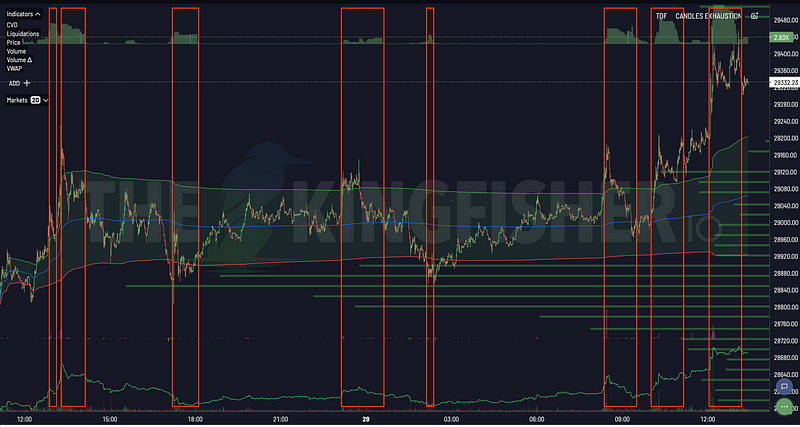
Toxic Order Flow Bitcoin: Detect Market Manipulation in Real-Time
Stop being exit liquidity. Learn how toxic order flow (TOF) reveals when whales are hunting retail traders. Practical guide with step-by-step interpretation and trading strategies.