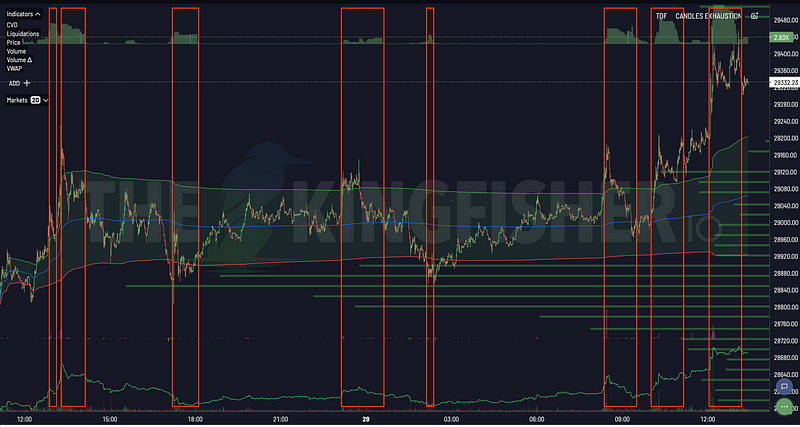

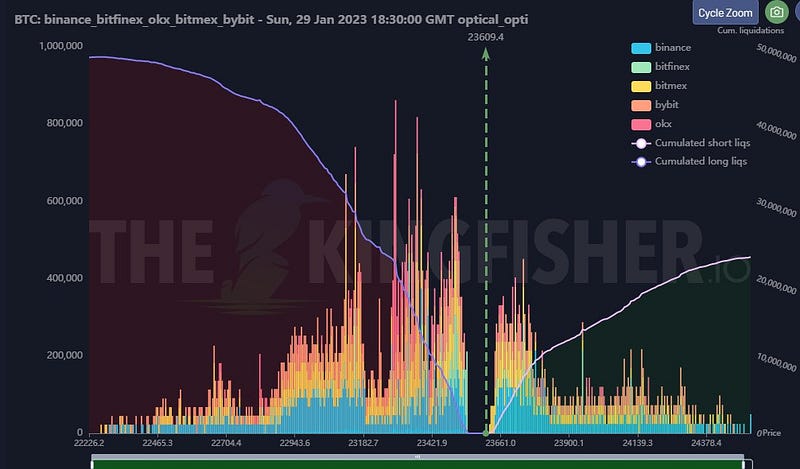
Liquidation heatmaps made a difficult research question visually accessible: where does a model estimate that leveraged positions may become vulnerable as price changes, and how have those estimates evolved across the displayed period?
That is a narrower and more defensible claim than saying a heatmap reveals every position or knows where price is headed. A LiqMap is a model-based visualization that presents relative zones a person can inspect. The Kingfisher model's specific inputs, weightings, and transformations are proprietary; its output must still be read within the visible scope, scale, product version, and timestamp.
The Kingfisher documents its own public chronology, archived material, and supporting sources on the history page. Readers interested in attribution should review those primary links directly. This article focuses on the visualization concept: why the format matters, how its parts should be read, and where interpretation often goes too far.
The problem the visual format addresses
Leveraged derivatives create conditional exposure. A position may be force-closed when an exchange's risk rules determine that available margin is insufficient. The operational threshold can depend on mark price, maintenance requirements, collateral, margin mode, fees, funding, position changes, and venue-specific rules.
Outside observers generally do not receive a complete account-level ledger containing all of those fields. Raw liquidation prints show events that have already occurred, while open interest and other public market data describe broader aggregates. Neither directly supplies a perfect map of future forced closures.
The visualization problem is therefore not “plot known private positions.” It is “represent a model's estimates in a form that exposes concentration, distance, and change without pretending the estimates are certain.” A liquidation map condenses the modeled price dimension. A liquidation heatmap adds the time dimension.
This was a meaningful interface shift because a long table of estimated levels is difficult to compare. Shapes, bands, and intensity let a reader notice structure quickly. Visual accessibility, however, can also create false confidence. A precise-looking band remains an estimate.
Liquidation map versus liquidation heatmap
The two terms are often used loosely, so it helps to separate them.
A Bitcoin liquidation map is primarily a price-level view at a selected observation. It makes relative concentrations easier to compare within the displayed settings. Depending on the interface, intensity may appear as bars, profiles, or another encoded shape.
A Bitcoin liquidation heatmap retains a sequence of model outputs. One axis represents time, another represents price, and color or brightness represents the modeled intensity according to the active scale. It helps a reader examine persistence and change: a zone can appear, strengthen, weaken, shift, or leave the displayed range.
One view is not more truthful than the other. They answer different descriptive questions. The map emphasizes the current cross-section; the heatmap emphasizes the path of estimates through the selected interval.
What the axes and color communicate
Price axis
The price axis locates estimated zones relative to the selected instrument's price scale. Before reading it, confirm the exact symbol, contract, quote currency, and venue or aggregate context shown by the interface. Similar tickers can represent different contracts.
A colored band should be discussed as a modeled area, not an exact instruction. Display resolution, binning, tick size, and smoothing can affect its apparent boundaries.
Time axis
On a heatmap, each column or segment corresponds to a time interval or update represented by the visualization. The meaning of that interval depends on the product implementation. A screenshot records what the interface showed, not necessarily when every underlying market event occurred.
For careful research, record the displayed time zone, observation time, selected range, and any source timestamp exposed by the product. Do not infer update frequency from animation or screen refresh behavior. Current definitions belong in the Kingfisher documentation.
Intensity scale
Color, brightness, height, or density encodes relative model output according to the active legend and product view. The underlying transformation is proprietary and should not be reverse-engineered from the visual. A stronger region helps compare zones within that view; it should not automatically be translated into a particular currency amount, probability, or expected price move.
Relative intensity makes a complex output easier to scan, but the same color in two screenshots is not necessarily like-for-like when their scales or settings differ. Any cross-chart comparison should preserve the legend, range, instrument, visible filters, and product version.
Direction labels
Color is not universally bullish or bearish. In many heatmaps it expresses intensity, not direction. A reader should use the legend rather than assign familiar red-green meanings. Even when a label distinguishes estimated long-side and short-side liquidations, it describes the modeled exposure category, not a recommendation.
What the modeled output represents
The Kingfisher LiqMap is generated by a proprietary model. This article does not disclose or speculate about its internal data selection, weighting, transformations, or calibration. Those implementation details cannot be recovered reliably from a screenshot, chart color, or public market series.
What a reader can verify is the output context exposed by the product: the instrument, venue or aggregate scope when shown, observation time, selected range, active filters, legend, and relative zones. Those fields make repeated observations more consistent without turning an estimate into an account-level fact.
Several practical limits remain. Traders can change positions or collateral, venue rules differ, timestamps and data availability can vary, and the displayed market context can change. The map is consequently an analytical estimate, not an exchange statement of future liquidations. Use current product documentation for visible controls and field definitions because an old screenshot may describe a previous version.
A disciplined way to read a heatmap
First: describe the panel
Record the instrument, selected range, time zone, price reference, scale, and visible legend. Note whether the panel represents one venue or an aggregate if the interface discloses that distinction.
Second: describe the pattern without a market story
Examples of neutral descriptions include:
- a high-intensity band remained visible across several displayed intervals;
- one modeled area weakened while the reference price stayed outside it;
- the scale changed after the visible price range expanded;
- multiple lower-intensity zones appeared close together;
- a historical band ended before price later crossed the same area.
None of those sentences claims that a zone attracts price, causes a reversal, or determines direction.
Third: label the interpretation
If you form a hypothesis, write it separately. Include at least one alternative explanation and one condition that would weaken the hypothesis. A zone can change as market conditions or the model output changes, because the visible scale changed, or because the selected product context is no longer like-for-like.
Fourth: define the review window in advance
Choose when the observation will be reviewed before seeing the outcome. Retain cases where little happens, the model changes, or the initial interpretation fails. Keeping only visually satisfying examples produces survivorship and selection bias.
Fifth: compare consistent settings
When comparing two screenshots, hold the instrument, contract context, range, legend, and scale constant where possible. If any setting differs, state it. A visual comparison without those controls can be misleading even when both images are authentic.
What a liquidation heatmap cannot tell you
It cannot reveal every private position
The visualization is not an account-level exchange ledger. It cannot be assumed to know every entry, margin balance, hedge, or position adjustment.
It cannot assign certainty to a zone
Intensity is model output. It does not establish that price reaches a level, that liquidation occurs there, or that a specific market reaction follows.
It cannot replace the order book
Estimated liquidation concentration is not the same as displayed or executable liquidity. A heatmap does not show a user's queue position, available fill quantity, fees, or exchange order status.
It cannot prove causation from chronology
Price crossing a previously displayed band does not, by itself, show that the band caused the move. Other market events can occur at the same time. Historical alignment is a prompt for further study, not proof.
It cannot preserve validity when context changes
An old screenshot may use different symbols, visible settings, scale, or product version. It is a historical artifact. It should not be presented as a current product specification or as evidence of repeatable market performance.
It cannot manage risk for the reader
The visualization does not know a person's financial situation, objectives, exposure, or exchange rules. It is not financial advice and should not be treated as an instruction to transact.
Common visual misreadings
“The brightest band is the next destination.” Brightness ranks modeled intensity under the active scale. It does not provide direction or timing.
“A band below price is support.” A potential liquidation area and a support level are different concepts. The chart does not promise a bounce, rejection, or continuation.
“The line is the exact liquidation price.” Display resolution and the model-based nature of the output make zone language more appropriate than point certainty. Actual account liquidation rules remain venue- and position-specific.
“The color gives a trade signal.” Color meaning comes from the legend. Intensity and exposure classification are not transaction instructions.
“A past interaction validates every future chart.” A memorable example cannot establish general reliability. Evaluation needs pre-defined rules, a sufficiently broad sample, retained counterexamples, and explicit uncertainty.
“Two providers' heatmaps can be compared by appearance.” Providers can use different proprietary methods, scales, time windows, and definitions. Similar colors do not imply like-for-like values.
How to evaluate a liquidation visualization
Rather than asking which screen looks most dramatic, use an audit framework:
| Dimension | Question |
|---|---|
| Definition | Does the provider clearly call the output an estimate or model? |
| Method | Does the provider state that the output is modeled, define its visible scope, and mark the proprietary boundary? |
| Instrument | Can the reader identify the exact contract and venue context? |
| Time | Are timestamps and their meanings available? |
| Scale | Is the intensity legend defined for the active view? |
| Change | Are methodology or product revisions documented? |
| Missingness | Does the interface distinguish unavailable data from zero? |
| Reproduction | Can a reader preserve settings and repeat an observation? |
| Claims | Are examples separated from promises about outcomes? |
| Access | Can current coverage and account conditions be verified directly? |
This framework is deliberately vendor-neutral. A polished rendering helps comprehension, but documentation and falsifiability determine whether the visualization can support serious research.
The origin story belongs with the evidence
Product-history claims are strongest when they link to dated material rather than relying on repeated slogans. The Kingfisher's history page assembles the company's chronology and the public sources it relies on. Readers can inspect those links and decide what each item establishes.
That evidence-first approach also protects the educational value of LiqMap. The format deserves to be understood as more than a colorful chart: it is an attempt to make uncertain, model-based leverage structure legible. Its usefulness depends on keeping the uncertainty visible.
A research notebook template
For each observation, preserve:
- instrument and contract label;
- venue or aggregate context shown;
- observation time and time zone;
- selected chart range;
- scale and legend;
- literal description of the modeled zones;
- separate interpretation and alternative explanation;
- pre-defined review time;
- outcome, including ambiguous cases;
- missing data or product changes.
After collecting a meaningful set, evaluate the method rather than the most vivid image. Ask how often settings changed, how many observations were inconclusive, whether screenshots were selected after outcomes were known, and whether the hypothesis survived counterexamples.
FAQ
Is a LiqMap a list of actual future liquidations?
No. It is model output estimating potential concentrations under a proprietary methodology. Actual forced closures depend on changing positions and exchange-specific risk mechanics.
What is the main difference between a map and a heatmap?
A map emphasizes modeled concentrations across price at a selected observation. A heatmap adds their displayed evolution through time.
Does a stronger color mean a larger expected market move?
Not necessarily. It represents intensity under the active model and scale. It does not specify outcome magnitude, direction, or probability.
Can historical screenshots demonstrate product performance?
They can document what a version of the interface displayed at a particular time. Without a pre-defined evaluation method and complete sample, they do not demonstrate repeatable performance.
Where can I verify current access and coverage?
Use the authenticated Kingfisher app for the screens and account conditions currently shown to you, and consult the documentation for current definitions. Do not infer current product facts from this historical article.
For a broader introduction, read the liquidation-map guide and compare the public map with the public heatmap.