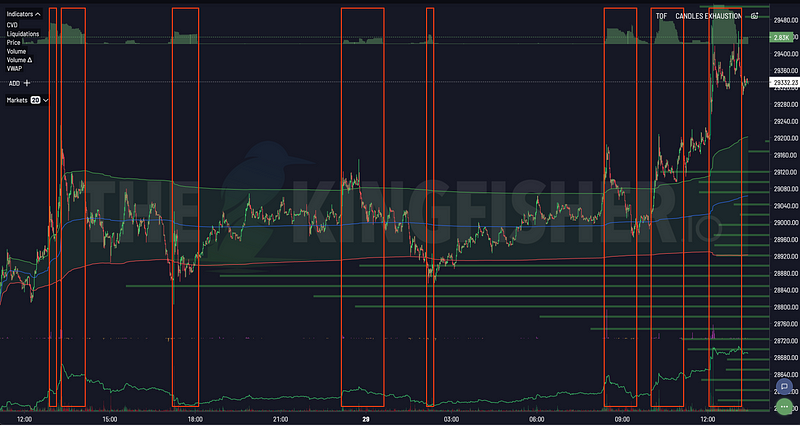

For years, quantitative analysis in crypto markets has followed a simple structure: data providers deliver indicators, and traders attempt to turn that information into decisions. But when markets accelerate, this approach reveals its limits. Knowing where a liquidation cluster sits is not enough. You also need to understand how orders interact with that level, whether available liquidity can absorb the movement, and when an apparent opportunity becomes a risk.
At TheKingfisher, we have spent the past several months investigating these questions. Our research now uses autonomous AI systems that formulate hypotheses, run controlled experiments, validate results, and preserve what each failed experiment teaches us. The goal is not to build a single AI model that claims to predict every market movement. Instead, we break complex market problems into smaller mechanisms, measure their usefulness, and combine the strongest components into compact risk models.
We are now making the results of this research available through our Premium and Pro offerings, with access through our interfaces, API, and MCP (Model Context Protocol) integrations. Here is what we have learned.
In this article
- Turning Market Intuition into Verifiable Research
- Why More Agents Do Not Automatically Produce More Discoveries
- Why We Favor Specialized Models Over a Single Large Predictor
- Faster Research Requires Stronger Validation
- The Real Constraint of Automated Trading: Execution Costs
- A New Generation of Trading Tools Built by Their Users
- What Remains Unsolved
- From Market Data to Quantitative Intelligence
Turning Market Intuition into Verifiable Research
Asking an AI model to generate a trading strategy is not the same as conducting scientific research. A model can discover misleading correlations, optimize parameters around historical noise, or introduce information that would not have been available when a trade was executed. These errors can produce impressive backtests with little predictive value. To reduce these risks, we developed an autonomous research environment built around four principles.
Define the hypothesis before the experiment
Each research agent must explain the mechanism it wants to test, the expected outcome, and the conditions that would invalidate the hypothesis. This prevents agents from inventing explanations after seeing favorable results.
Isolate changes
When an experiment improves performance, we need to identify what caused the improvement. Controlled changes help prevent unrelated mechanisms from being mixed into a single experiment.
Attempt to falsify every result
Our experiments include negative controls, chronological data separation, and tests on data that was not used during development. A promising signal must survive conditions different from those in which it was discovered.
Separate discovery from validation
An agent that proposes a hypothesis should not be the sole authority deciding whether it works. Independent validation examines reproducibility, transaction costs, slippage, funding, and market constraints. This framework changes the role of AI in our research.
AI does not replace the scientific method. It allows us to apply it across more experiments with consistent validation rules.
Why More Agents Do Not Automatically Produce More Discoveries
One of our most important findings concerns collaboration between AI agents. Increasing the number of agents working on a problem does not guarantee higher productivity. Without coordination, agents repeat experiments, propagate unverified conclusions, and converge on similar ideas. We observed these limitations during our own multi-agent research campaigns. To address them, we moved beyond unrestricted agent conversations toward an architecture based on structured hypotheses and verifiable evidence.
Our system preserves relationships between research questions, experiments, observations, and conclusions. Each finding can be connected to the evidence supporting it. Each rejected hypothesis retains an explanation of why it failed. This changes how agents collaborate. Instead of repeating completed experiments, an agent can use previous results, identify unresolved questions, and explore a different direction. We also investigated how different reasoning capabilities can work together: hypothesis generation, critical evaluation, and independent verification.
This approach reduced redundant work and improved the efficiency of our experimental campaigns. But its greatest benefit is more fundamental:
A failed experiment becomes reusable knowledge.
A strategy that fails under certain market conditions, a filter that removes too many opportunities, or a model that loses its advantage after transaction costs are included still produces useful information. Preserving those findings helps us avoid rediscovering the same mistakes. Over time, the system accumulates not only successful ideas but also a structured understanding of what does not work.
Why We Favor Specialized Models Over a Single Large Predictor
Crypto markets combine multiple processes operating at different speeds. The order book describes available liquidity. Executed trades reveal actual buying and selling pressure. Potential liquidation levels indicate areas where price movements may trigger forced market activity. No single indicator captures the entire process. Our research has therefore moved toward a modular approach: solve specific problems with mathematical transformations or compact models, then evaluate how these components behave when combined.
This makes it easier to validate components independently, control complexity, and replace mechanisms that no longer perform under changing market conditions. Three areas illustrate this approach.
Understanding Order Flow in the Context of Liquidations
Order flow imbalance indicators, including metrics such as VPIN, attempt to measure potentially toxic trading activity. They can help identify situations in which aggressive transactions place unusual pressure on available liquidity. But the same imbalance does not carry the same meaning in every market environment. Heavy selling pressure in a deep, liquid market may produce a different outcome from similar activity near a concentration of potential liquidations.
We therefore investigated how liquidation data can improve the interpretation of order flow. Our experiments indicate that liquidation context can increase the usefulness of certain microstructure signals compared with using those signals independently. This supports an important principle behind TheKingfisher. Liquidation maps are not simply visual representations of market activity. They provide information that can be combined with other market data to evaluate risk scenarios.
Why Good Entry and Exit Rules Can Work Poorly Together
A strategy can have a useful entry signal and a reasonable exit rule without producing good results when both are combined. The reason is execution. A trade is not just a theoretical decision. It must be executed through a real order book, with changing liquidity, queue position, spreads, and adverse selection. Our experiments showed that some improvements lost their value when combined without considering these execution constraints.
For example, a signal may identify an attractive market opportunity, but the conditions under which an order gets filled can change the expected outcome. This can create adverse selection: orders are executed under conditions that become unfavorable shortly after the fill. The conclusion is straightforward:
Execution quality is part of signal quality.
Entry logic, exit logic, risk management, and order placement cannot always be optimized independently. They must also be evaluated as a complete system.
Detecting Opportunities That Lose Their Advantage
Not every losing trade begins with a sharp move against the position. Some trades deteriorate because the expected move never develops. An opportunity that initially looks attractive can lose its value when volatility contracts, liquidity changes, or the market enters consolidation. This led us to investigate lightweight models that evaluate how an opportunity changes after its initial conditions appear.
Rather than attempting to predict every future price movement, these models help identify situations in which a position may no longer justify its risk. In historical validation, selective filtering reduced exposure to certain unfavorable market conditions and improved the results of the strategies we studied. These findings depend on the evaluation period, market environment, and execution assumptions. However, they demonstrate the potential value of combining several specialized models into a coordinated risk framework.
Faster Research Requires Stronger Validation
Autonomous research makes it possible to explore more hypotheses. It also creates more opportunities for error. During development, differences between historical simulations and prospective observations led us to strengthen our software controls and validation procedures. These investigations reinforced an important lesson: errors in data handling, system integration, or experiment configuration can change the apparent performance of a model. Even when a mathematical model is correct, its integration into a larger system can introduce unexpected behavior.
We therefore expanded our consistency checks, reproducibility requirements, and comparisons between simulated and observed results. Our research environment also helps improve its own tools. Numerical optimization, computational profiling, and automated testing reduce the cost of evaluating new hypotheses. These improvements allow us to run more experiments and dedicate more resources to independent verification. But faster experimentation does not automatically mean better discoveries.
Research speed matters only when the quality of evidence improves with it.
The Real Constraint of Automated Trading: Execution Costs
Many trading strategies are developed and evaluated primarily using historical price data. This is useful for exploring ideas, but it cannot fully describe how a strategy will behave in production. Between detecting a signal and executing a trade, several factors can change the result:
- Trading fees and bid-ask spreads
- Slippage and available liquidity
- Funding costs
- Execution latency and order queue position
A strategy that appears profitable before these costs may lose its advantage once realistic execution assumptions are included. Our simulation campaigns confirmed that several approaches are sensitive to these constraints. They also showed the potential benefits of combining liquidation information, microstructure signals, and risk controls. This does not mean that any model can guarantee profitable execution. It means a decision system must evaluate more than the apparent opportunity.
It must also account for the cost and risk of acting on that opportunity. This distinction becomes essential when moving from research to live execution.
A New Generation of Trading Tools Built by Their Users
AI coding assistants and agent protocols are changing how traders build software. Developers and independent traders can now create customized analytics, connect multiple data sources, and automate research workflows with fewer engineering resources. This is accelerating the shift toward Do-It-Yourself (DIY) trading infrastructure. Users can build tools designed around their own account sizes, risk limits, and execution requirements. But easier software development does not eliminate the fundamental challenges of quantitative trading.
Traders still need reliable data, validated hypotheses, effective risk controls, and a clear understanding of execution constraints. This is where we want TheKingfisher to provide value. Our objective is not to force users into another closed trading platform. We want to provide a quantitative intelligence layer that can be integrated into the tools they already use or choose to build.
Separating Risk Intelligence from Trade Execution
Our approach separates two responsibilities.
TheKingfisher provides analytical intelligence: liquidation maps, market microstructure indicators, specialized risk signals, and insights derived from our research models.
Users retain control over execution: their trading decisions, risk parameters, infrastructure, and exchange credentials.
This separation makes it possible to integrate our data into different environments without requiring a specific trading engine or order management system. It also reduces the need to delegate sensitive execution permissions to external services.
API and MCP: Making Research Accessible to AI Agents
Our services can be accessed through TheKingfisher interfaces or integrated into external applications through our API and MCP support. Developers can use liquidation information and risk signals in custom dashboards, alert systems, research environments, and automated analysis workflows. MCP provides a standardized interface through which compatible AI applications can access external tools and data sources. This creates new possibilities for autonomous research and quantitative analysis.
Instead of rebuilding every component from scratch, developers can connect specialized market intelligence to their existing systems.
Open and Auditable Infrastructure
We favor an approach in which integration components can be inspected and controlled by their users. Open-source software can play an important role, particularly for connectors and tools that run inside a trader's own environment. Transparency makes it easier to review dependencies, inspect how credentials are handled, and understand how orders are submitted. We believe users should retain control over their credentials, permissions, and execution systems.
Market intelligence should be accessible without requiring traders to surrender that control.
What Remains Unsolved
Our research has identified useful patterns, but it has also shown how strongly performance depends on market conditions. Some signals become less informative during prolonged volatility compression. Others deteriorate when liquidity changes or execution costs increase. Detecting these transitions, adapting risk models, and measuring uncertainty remain important research challenges. We are also continuing to investigate how to improve multi-agent collaboration, strengthen validation, and combine specialized models without losing their individual advantages.
The objective is not to discover a universal trading strategy. It is to build a research process that can generate hypotheses, test them, reject weak ideas, and improve the quality of its conclusions. A process that remembers failed experiments, identifies its own limitations, and continually challenges its assumptions.
From Market Data to Quantitative Intelligence
Crypto markets do not lack indicators. The real challenge is determining which information matters, under what conditions it matters, and what risks arise when acting on it. That is what we are building at TheKingfisher. Our autonomous research systems allow us to investigate more market mechanisms, preserve experimental evidence, and turn validated findings into specialized analytical tools.
We are now making these capabilities accessible through our Premium and Pro offerings, dedicated interfaces, API, and MCP integrations. Our vision is straightforward:
Give traders the intelligence to build their own systems, supported by high-quality market data, specialized risk models, and full control over execution.
The future of quantitative trading may not depend on building one increasingly large prediction model. It may depend on better data, stronger experiments, and smaller specialized models that work together.
Historical performance, simulations, and experimental validation do not guarantee future results. The models discussed here are intended for market analysis and risk assessment, not as trading instructions.