

Toxic Order Flow Bitcoin: Detect Market Manipulation in Real-Time
Ever wonder why price suddenly reverses right after your entry? You're not unlucky, you're being hunted.
Toxic Order Flow (TOF) reveals when informed traders (whales, market makers) are actively trading against uninformed participants (retail FOMO). When TOF spikes, volatility follows.
In this guide:
- Step-by-step TOF interpretation
- How to trade using toxic flow signals
- Real examples of market manipulation detection
- TOF vs other indicators comparison
What is Toxic Order Flow?
Toxic Order Flow refers to trades executed at unfavorable prices, typically when retail traders provide liquidity to informed traders who possess superior information. The colors in TOF differentiate between Bybit and Binance exchanges (showing where toxic flow is coming from), not toxicity levels.
Think of it like poker:
- Informed traders = Professional players who can see the cards
- Uninformed traders = Recreational players betting blindly
- Toxic flow = When the pros are heavily betting one direction
When TOF increases, it signals that market participants with an informational edge are actively trading. This often precedes significant price movements.
The Science Behind TOF: VPIN
The study of Toxic Order Flow uses VPIN (Volume-synchronized Probability of Informed Trading), developed by Easley, Prado, and O'Hara in 2012. Their research proved that:
- High VPIN = Incoming volatility spike
- Informed trading concentration = Price movement predictor
Kingfisher adapted this model for crypto markets, allowing traders to see manipulation in real-time.
What is TOF?
By analyzing the rate at which trades happen in a given market, one can identify the probability that part of order flow belongs to informed traders, as well as their proportion vs the whole trading volume. The greater the probability and share of said volume being informed, the more likely a spike in volatility is to occur rather soon.
The more relevant the "informed traders' information", the stronger the volume imbalance will be.
Important: As per the authors' observation, though VPIN is a strong indicator of informed trading and toxicity, its absolute value is rather "meaningless". Compare different VPIN numbers between each other rather than considering VPIN levels independently.
How to Interpret Toxic Order Flow: Step-by-Step
Step 1: Identify TOF Spikes
Look for sudden increases in the TOF indicator on your chart. These spikes represent moments when informed traders are aggressively executing orders.
What to look for:
- Sharp vertical spikes in TOF
- Multiple spikes in quick succession
- TOF rising while price consolidates
Step 2: Analyze Context
Not all TOF spikes are equal. Consider:
Price location:
- Near liquidation clusters? (highly significant)
- At support/resistance levels?
- During consolidation or trending moves?
Market conditions:
- Is liquidity draining?
- Are spreads widening?
- Is volume abnormal?
Step 3: Watch for Liquidity Drain
As documented by Jiang Jinzhi (2015), there's a positive feedback loop between TOF and high-frequency liquidity:
- Negative liquidity shock (like liquidations) boosts VPIN locally
- This leads to further liquidity drain
- Which likely triggers further liquidations
- Creating a cascade effect
Keep your eye on VPIN when approaching liquidation clusters as depicted by the Kingfisher's liquidation maps.
Step 4: Time Your Entry
TOF is primarily a short-term indicator. Use it for:
- Scalping: Trade local mean reversion after TOF spikes
- Confirmation: Validate liquidation map signals
- Timing: Enter before volatility explodes
How to Trade Using Toxic Order Flow
Setup 1: The TOF Reversal
Conditions:
- TOF spikes sharply
- Price extends in spike direction
- Volume surge shows exhaustion
- Enter reversal against the spike
Example: Heavy buy TOF into resistance → Wait for exhaustion → Short the rejection
Setup 2: TOF + Liquidation Map Combo
Most powerful setup.
- Identify liquidation cluster on Kingfisher map
- Watch TOF build as price approaches cluster
- Wait for TOF spike at the cluster level
- Enter trade toward the cluster
- Exit as cluster triggers
This is how you catch liquidation cascades before they happen.
Setup 3: Pre-Volatility Positioning
When TOF steadily rises without price movement:
- Market makers are removing liquidity
- Spread is widening
- Big move imminent
Action: Position for breakout, wait for TOF explosion
Real Trade Example: Classic Liquidation Hunt
Here's how TOF reveals market manipulation in action through TOF and other available HFT metrics:
Market Setup
Bitcoin's price shot up over 6% within 8 hours during the Asian session. Liquidations and toxic order flow explained exactly what happened.
Step-by-Step Breakdown
1. Liquidity Buildup (Box 1)
- Right before the first pump, a short liquidation cluster built up above price
- This was visible on the Kingfisher liquidation map
- Whales saw the trapped liquidity
2. TOF Starts Building (Box 2)
- Toxic Order Flow started increasing
- Market makers slowly began removing liquidity
- Smart money positioning began
3. New Cluster Forms (Box 3)
- Pulling a short-term liquidation map showed a new short cluster
- Built up right below the previous high
- Even more fuel for the upside
4. TOF Acceleration
- Toxic order flow increased further
- Liquidity drained locally again
- Market makers widened spreads significantly
- The trap was set
5. Liquidation Cascade 🎣
- All shorts got liquidated
- Price rocketed through the clusters
- Late longs got wrecked at the top
Thanks for playing!
Textbook liq hunt + Toxic order flow in action
TOF on Different Timeframes
1-Minute Timeframe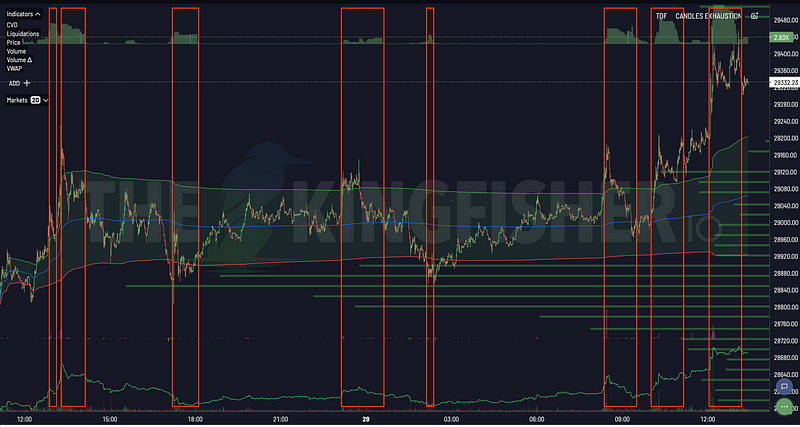
For scalping:
- Spikes show over-extended price action
- Trade local mean reversion
- Quick profits from exhaustion
Note: The green range represents VWAP bands, available to all Kingfisher users
4-Hour Timeframe
For swing trading:
- TOF shows longer-term manipulation patterns
- Major reversals often preceded by sustained TOF
- Combines perfectly with liquidation maps
TOF vs Other Indicators
| Indicator | What It Shows | Timeframe | Best For |
|---|---|---|---|
| TOF | Informed trading presence | Short-term | Volatility prediction, reversal timing |
| CVD | Buy/sell volume imbalance | Short/Medium | Trend confirmation, absorption detection |
| Liquidation Maps | Where price wants to go | All setups | Entry levels, profit targets |
| RSI | Overbought/oversold | Medium | Momentum extremes |
| VWAP | Average price vs value | All | Trend direction, mean reversion |
Key insight: TOF is unique because it shows informational advantage, not just price or volume action.
Common TOF Mistakes
| Mistake | Why It Fails | Fix |
|---|---|---|
| Trading TOF spikes blindly | False signals during trends | Combine with liquidation maps |
| Ignoring TOF buildup | Missing big moves | Watch for steady TOF rise, not just spikes |
| Using TOF in isolation | No context = bad entries | Always consider location and clusters |
| Ignoring timeframe | Signals conflict | Trade TOF on timeframe matching your style |
Quick Reference: TOF Trading Checklist
Before entering any TOF-based trade:
- Is TOF spiking or building steadily?
- Is price near a liquidation cluster?
- Is liquidity draining (spreads widening)?
- What's the timeframe context?
- Where will you exit (profit target)?
- What's your risk if wrong?
Advanced: TOF + GEX Analysis
For professional-level analysis, combine TOF with:
Gamma Exposure (GEX):
- Shows dealer positioning
- Negative GEX + High TOF = Volatility explosion
- Positive GEX + High TOF = Suppressed volatility (trap)
Kingfisher Pro provides both TOF and GEX in real-time.
Get Started with TOF Trading
What Kingfisher provides:
- Real-time TOF across multiple timeframes
- Liquidation maps with cluster visualization
- TOF + CVD + GEX combined
- Historical TOF analysis
Get started:
- Try Kingfisher free - Use premium features with daily spins
- Explore Kingfisher features - See the full platform
- Join the community - Share your TOF setups
- Documentation - Deep explore indicators
FAQ
Q: Is TOF reliable for trading? A: Yes, but combine it with liquidation maps. TOF shows manipulation potential, liquidation maps show where it'll play out.
Q: What timeframe is best for TOF? A: 1-minute for scalping, 15-minute for day trading, 4-hour for swing. Match timeframe to your trading style.
Q: Can TOF predict direction? A: Not directly. TOF predicts volatility, not direction. Use liquidation maps to determine direction, TOF for timing.
Q: What's the difference between TOF and CVD? A: TOF shows informed vs uninformed trading. CVD shows buy vs sell pressure. They complement each other perfectly.
Q: Do I need VPIN knowledge to trade TOF? A: No. Kingfisher calculates TOF automatically. You just need to interpret the spikes and context.
Updated: January 2026 | Related: CVD Trading Guide | Getting Started | TOF Deep Dive (modern guide)
Related Articles
Unlock the Potential of Crypto Trading
Dive into the Deep End with The Kingfisher's Advanced Market Analytics!

Glossary
Learn key terms and concepts from our comprehensive crypto trading glossary.
Browse Glossary →Related Articles
How to Detect Crypto Market Manipulation in Real-Time
Stop being played by whales. Learn to spot crypto manipulation before it costs you money using Kingfisher's Toxic Order Flow and liquidation data. Real examples included.

Options Skew Templates for Perp Traders: Complete Guide to Using Skew Data on Kingfisher
Master options skew data for perpetual futures trading. Learn how to read and use Skew templates on Kingfisher, understand different template types (Basic, Vanilla, Premium), when each template works best, and how to combine skew analysis with LiqMap confirmation for high-probability crypto trading setups.

Getting Started on The Kingfisher: Stop Being Exit Liquidity
What problem does Kingfisher solve? See how liquidation maps reveal where price will go BEFORE it moves there. Stop getting hunted by whales. Start trading with an edge in 10 minutes.
Toxic Order Flow Bitcoin: Detect Market Manipulation in Real-Time
Stop being exit liquidity. Learn how toxic order flow (TOF) reveals when whales are hunting retail traders. Practical guide with step-by-step interpretation and trading strategies.