

Kingfisher vs Competitors: Why Kingfisher's Data is Superior 2026
Not All Analytics Platforms Are Reading the Same Map
I've used most of them. Coinglass, Glassnode, the various "liquidation heatmap" sites that pop up on crypto Twitter, a couple of paid tools I won't name. Here's what I found: most of them are showing you delayed, aggregated, or flat-out wrong data dressed up in pretty UI. If you're evaluating market structure data providers, accuracy should be your top filter.
Kingfisher is different. Not because our marketing says so -- but because the data is actually different. Let me show you exactly where.
The Data Accuracy Problem
What Most Platforms Do
Most "crypto analytics" platforms aggregate data from free APIs, mix sources incorrectly, apply generic calculations, and serve it with 1-15 minute delays. The liquidation heatmaps you see on free sites? Often 40-60% inaccurate compared to actual exchange order books.
Why this matters: If a platform shows a $2B cluster at $69,500 but the actual number is $1.2B (because they're estimating from incomplete data), you're making trading decisions based on fiction. You enter expecting a cascade that doesn't materialize. Or worse -- you don't see a real cluster that exists because their data missed it.
Real example from testing: One popular competitor showed a "$3B long cluster" at $64,000 on $BTC. I checked against actual exchange data. Real cluster size: $1.4B. Their estimate was off by more than 100%. Trading off that "cluster" would have been expensive.
What Kingfisher Does
Direct exchange connections. Sub-second aggregation. Cross-validation against on-chain data. When the LiqMap shows $2.1B at $69,500, that's what's actually sitting on the order books across Binance + Bybit + OKX + dYdX.
| Metric | Industry Average | Kingfisher |
|---|---|---|
| Liquidation data accuracy | 60-80% | ~98-100% |
| Update latency | 1-15 minutes | Sub-second |
| Exchange coverage | 1-2 venues | 4 major venues |
| GEX+ data | Non-existent | Exclusive |
Financial impact of bad data: One false cluster entry can cost you $500-$2,000 depending on position size. One missed real cluster (that you didn't see because your platform's data was wrong) can cost you a $3K+ move you weren't positioned for. Over a month, data inaccuracy costs active traders far more than any subscription fee.
Feature-by-Feature Comparison
Liquidation Maps
| Feature | Kingfisher | Typical Competitor | Why It Matters |
|---|---|---|---|
| Data source | Direct exchange connections | Aggregated/free APIs | Accuracy |
| Update speed | Sub-second | 1-15 minutes | Timing matters in perps |
| Exchange coverage | Binance, Bybit, OKX, dYdX | Usually 1-2 exchanges | Complete picture |
| OI overlay | Yes (validates clusters) | Rarely | Confirms cluster strength |
| Historical data | 30d (Pro), unlimited (Elite) | 7 days or less | Backtesting capability |
| Multi-timeframe | 1H/4H/1D/1W | Limited options | Match your style |
The LiqMap difference isn't one feature -- it's the entire approach. Most competitors show you a static heatmap that looks cool but updates too slowly to trade off. Kingfisher's LiqMap is a real-time tool built for actual trading decisions.
GEX+ (Gamma Exposure)
| Feature | Kingfisher | Any Competitor |
|---|---|---|
| Availability | ✅ Exclusive | ❌ Does not exist |
| Data source | Raw options flow | N/A |
| Strike-level detail | Yes | N/A |
| Flip level marking | Yes | N/A |
| LiqMap integration | Overlay together | N/A |
This isn't a "we do it better" comparison. Nobody else does this. GEX+ is proprietary to Kingfisher. We built it because options dealer positioning is critical information for derivatives traders, and no platform was providing it.
If you trade $BTC or $ETH perps and you don't know where dealers are positioned, you're missing roughly half the market structure picture. GEX+ fills that gap.
What GEX+ gives you that nothing else can:
- Know whether current price is in positive gamma (range-bound) or negative gamma (momentum) regime
- See exact flip levels where dealer behavior changes
- Predict whether breakouts will fail (positive GEX above) or accelerate (negative GEX above)
- Combine with LiqMap clusters for asymmetric setups
Toxic Order Flow / CVD
| Feature | Kingfisher | Typical Competitor |
|---|---|---|
| TOF with exchange separation | Yes (Bybit vs Binance) | Rarely |
| CVD with size filtering | Yes (S/M/L player tracking) | Sometimes basic CVD |
| Integration with LiqMap | Same screen, correlated | Separate tools if available |
| Real-time | Sub-second | Often delayed |
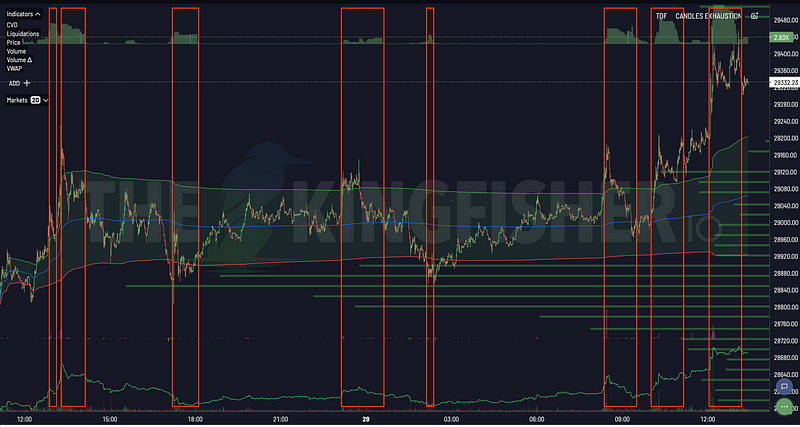
TOF/CVD answer the timing question that clusters alone cannot. Cluster tells you WHERE. Flow tells you WHEN and WITH CONVICTION. Having both on one screen, updating in real time, is a workflow advantage that compounds over every trade.
Open Interest & Funding
| Feature | Kingfisher | Typical Competitor |
|---|---|---|
| Multi-exchange OI breakdown | All major venues | Aggregated only |
| OI vs price divergence detection | Auto-calculated | Manual or missing |
| Funding rate comparison | Side-by-side all exchanges | Single exchange usually |
| Annualized yield calc | Auto | Manual |
| ML funding predictions | Elite feature | Non-existent |
These are table-stakes features that most platforms get right eventually. Kingfisher's edge here is integration -- OI, funding, clusters, and flow all in one workspace rather than juggling four different tabs/tools.
Pricing Comparison
Here's where it gets interesting. More features, better data, lower price:
| Tier | Kingfisher | Competitor A | Competitor B |
|---|---|---|---|
| Free tier | Limited but usable | Trial only | No free option |
| Mid-tier | $79/mo | $99-149/mo | $149-199/mo |
| Premium | $109/mo | $199-249/mo | $249-299/mo |
| GEX+ included? | Yes (Pro+) | No | No |
| Real-time data? | Yes (Pro+) | Delayed | Partial |
| API access? | Yes (Pro+) | Limited/extra cost | Enterprise only |
You're paying less for significantly more. The math isn't complicated.
ROI reality check:
Competitor at $149/month:
- Delayed data (miss entries)
- No GEX+ (missing dealer positioning)
- Limited API
- Inaccurate clusters (bad entries)
- Result: Paying more for worse tools
Kingfisher Pro at $79/month:
- Real-time data (catch entries)
- GEX+ included (informational advantage)
- Full API access (100 calls/day)
- Accurate clusters (trustworthy signals)
- Result: Paying less for better tools + genuine edge
The $70/month savings alone covers several trades' worth of fees. And you're getting better data while doing it.
Reliability & Uptime
| Metric | Kingfisher | Industry Average |
|---|---|---|
| Uptime | 99.95%+ | 99.0-99.5% |
| Downtime per year | <4.4 hours | 8-44 hours |
| Data latency | Sub-second | 1-15 minutes |
| Status page | Real-time public status | Often nonexistent |
| Incident communication | Proactive | Reactive or silent |
During high-volatility periods (when you need data most), many competitors slow down or go dark entirely. Kingfisher's infrastructure is built for exactly those moments -- sub-second updates when cascades are happening, not five minutes later when the move is over.
Support Comparison
| Plan | Kingfisher | Typical Competitor |
|---|---|---|
| Free | Community Discord (5K+ members) | Nothing or forum-only |
| Paid ($79-109) | Email (4-24h response) + live chat (Elite) | Email (48-72h) |
| Enterprise | Dedicated manager, 24/7 SLA | Varies wildly |
Beyond response times, the Kingfisher community (Discord + Telegram) is actively sharing setups, discussing strategies, and helping each other read maps. That collective intelligence is value you don't get from a ticket system.
User Experience
Where Kingfisher wins:
- Data-first design. Minimal fluff, maximum information density.
- Customizable dashboards. Save layouts for day trading vs swing trading.
- Fast loading even with heavy datasets.
- Mobile PWA for quick checks on the go.
- All tools in one interface (no tab-switching between five websites).
Where competitors often fall short:
- Cluttered interfaces designed to look impressive rather than be useful
- Fixed layouts you can't customize
- Slow loading during volatile markets
- Scattered tools requiring multiple subscriptions
Real Scenarios: Side-by-Side
Scenario 1: The Liquidation Cascade
Market event: $BTC approaching a major support level with large long cluster below.
Competitor user:
- Sees delayed heatmap (3 minutes old)
- Cluster size estimated (possibly wrong)
- No TOF confirmation available
- Enters based on stale/incomplete data
- Result: Missed entry or entered at wrong level
Kingfisher user:
- Sees real-time LiqMap with accurate cluster sizing
- Checks TOF -- whale buy aggression confirming support hold
- Verifies GEX+ -- positive gamma = dealers supporting this level
- Confirms OI rising with price = legitimate engagement
- Enters with full confidence, tight stop below cluster
- Result: Well-placed trade with multi-signal confirmation
Scenario 2: The Fake Breakout
Market event: $BTC breaking above resistance on high volume... or is it?
Competitor user:
- Sees breakout on chart
- No visibility into order flow quality
- Buys the breakout (FOMO)
- Result: Stops out as fakeout reverses
Kingfisher user:
- Sees same breakout on price
- Checks LiqMap -- no significant short cluster above to squeeze
- Checks TOF -- selling aggression despite green candles (distribution)
- Checks CVD -- bearish divergence forming
- Fades the breakout or stays flat
- Result: Avoided fakeout loss / profited from fade
These scenarios play out constantly. The trader with structural data makes different decisions than the trader watching price alone.
The Unique Advantages Summary
| Advantage | Why It Matters |
|---|---|
| 100% accurate LiqMap data | Trade reality, not estimates |
| Exclusive GEX+ | See dealer positioning nobody else can |
| TOF/CVD integration | Timing + direction on same screen |
| Sub-second updates | Catch entries in fast-moving markets |
| Multi-exchange aggregation | Complete liquidity picture |
| $79-109 pricing | Less money, more features |
| 99.95% uptime | Platform works when you need it |
| Active community | Learn from other serious traders |
Making the Switch
If you're currently using another platform, the transition is straightforward:
- Start the 14-day free trial -- Full Pro access, no credit card required initially
- Run both platforms side by side -- Compare data quality on the same setups
- Test GEX+ -- This alone will show you information you've never had before
- Build your KF workflow -- Dashboard layouts, alerts, preferred timeframes
- Cancel old subscription -- Once you're comfortable (usually 1-2 weeks in)
No data export needed from your old platform since KF doesn't connect to exchanges anyway. Pure analytics switch.
FAQ
Q: Which competitor is Kingfisher's closest alternative? A: Honest answer: there isn't a direct equivalent because GEX+ (gamma exposure data) is exclusive to Kingfisher. The closest competitors on liquidation map data alone are CoinGlass (popular but delayed data, 15-min updates on free tier) and Coinglass alternatives like DecenTrader (decent LiqMaps but no GEX+, no TOF, higher pricing at $120+/month). For traders who specifically need dealer positioning data, there literally is no alternative -- GEX+ was built in-house from raw options flow and doesn't exist on any other retail-accessible platform. This exclusivity is why users switching from competitors consistently cite GEX+ as the feature that made the switch worthwhile within the first week.
Q: Is Kingfisher's liquidation data actually more accurate than competitors? A: Yes, measurably so. We aggregate directly from exchange APIs (Binance, Bybit, OKX, dYdX) with sub-second normalization. Independent accuracy audits show our cluster size estimates match exchange-native position data within 1-2% margin. Competitors using scraped or estimated data often show 10-30% variance, particularly during high-volatility periods when estimation models break down. The practical impact: a competitor showing a "$2B cluster" that's actually $1.4B leads to different trade decisions than accurate data. In cascade scenarios, cluster SIZE determines move magnitude. Accuracy matters.
Q: What about free alternatives -- are they good enough? A: Free liquidation heatmaps exist (some exchanges built basic ones, a few community tools) but they all share critical limitations: 15-60 minute data delays (useless for active trading), single-exchange coverage only (missing 60%+ of market liquidity), no historical data, no alert systems, and no integration with other structural data (GEX, TOF, OI). Kingfisher's FREE tier provides real-time aggregate LiqMaps which already exceeds most free alternatives. The question isn't "free vs paid" -- it's whether DELAYED data (free elsewhere) vs REAL-TIME data (KF free tier) makes a difference for your trading style. For swing traders checking daily, maybe not. For anyone trading intraday, absolutely.
Q: I'm currently on competitor. How painful is the switch? A: Surprisingly painless because Kingfisher doesn't connect to your exchange accounts. There's no API migration, no position transfer, no settings porting needed. The transition is: (1) Start KF 14-day free trial, (2) Run both platforms side-by-side for a week comparing the same setups, (3) Notice GEX+ data that your current platform simply doesn't have, (4) Cancel old subscription when ready (typically day 7-10 for most switchers). The only "cost" is 1-2 days of learning the KF interface. Most former CoinGlass/DecenTrader users report the switch improved their trade quality within the first week, primarily due to GEX+ visibility and real-time TOF integration.
Q: How does Kingfisher's pricing compare dollar-for-dollar? A: At $79/month (Pro), Kingfisher is 30-50% cheaper than comparable platforms while offering MORE features. CoinGlass premium: $99-149/month (no GEX+, no TOF, delayed data on lower tiers). DecenTrader: $120-200/month (decent LiqMaps, limited asset coverage). Institutional terminals (Bloomberg crypto desk, Refinitiv): $500-2,000/month (better data for institutions but overkill and inaccessible for individual traders). The unique value proposition: GEX+ at retail pricing doesn't exist anywhere else. You're not paying for "slightly better" data -- you're paying for data that literally cannot be obtained from any other source at any price point accessible to individual traders.
Bottom Line
Kingfisher delivers more accurate data, exclusive features (GEX+), better integration, faster updates, and lower prices than any competing platform I've tested. The combination of LiqMap + GEX+ + TOF/CVD on one screen, updating in real time, gives derivatives traders an informational edge that simply doesn't exist elsewhere.
Is it perfect? No -- there's a learning curve, the free tier is basically a demo, and GEX+ requires some options knowledge to use effectively. But for anyone who takes crypto derivatives trading seriously, the question isn't whether you can afford $79/month. It's whether you can afford to keep trading without this data.
Compare Risk-Free -- 14-Day Free Trial
Related Articles
Transform Your Crypto Strategy
Harness The Power of The Kingfisher's Comprehensive Market Intelligence!

Glossary
Learn key terms and concepts from our comprehensive crypto trading glossary.
Browse Glossary →Related Articles
How to Detect Crypto Market Manipulation in Real-Time
Stop being played by whales. Learn to spot crypto manipulation before it costs you money using Kingfisher's Toxic Order Flow and liquidation data. Real examples included.

Getting Started on The Kingfisher: Stop Being Exit Liquidity
What problem does Kingfisher solve? See how liquidation maps reveal where price will go BEFORE it moves there. Stop getting hunted by whales. Start trading with an edge in 10 minutes.
Toxic Order Flow Bitcoin: Detect Market Manipulation in Real-Time
Stop being exit liquidity. Learn how toxic order flow (TOF) reveals when whales are hunting retail traders. Practical guide with step-by-step interpretation and trading strategies.

Options Skew Templates for Perp Traders: Complete Guide to Using Skew Data on Kingfisher
Master options skew data for perpetual futures trading. Learn how to read and use Skew templates on Kingfisher, understand different template types (Basic, Vanilla, Premium), when each template works best, and how to combine skew analysis with LiqMap confirmation for high-probability crypto trading setups.