

What is FUD in Crypto? Understanding Fear, Uncertainty, and Doubt 2026
Someone Wants Your Bags Cheap. Here's How They Get Them.
FUD = Fear, Uncertainty, Doubt. It's a weapon. And in crypto's 24/7 news cycle, it gets deployed constantly.
Someone shorts the market, then an "anonymous source" drops a headline about regulation. Price dumps. Retail panics. That same someone accumulates at the discount they just created. Rinse, repeat.
This isn't conspiracy theory. It's market mechanics. Understanding what is FUD -- how to spot it, when to fade it, and when it's actually legitimate -- separates traders who get shaken out from traders who buy the dip everyone else is selling.
Let's break down exactly how FUD works, what it looks like on-chain, and how Kingfisher's objective data cuts through the noise.
What is FUD? The Anatomy
Definition
FUD is the strategic spread of negative, vague, or outright false information designed to trigger emotional selling. It's not one person with a bad take -- it's coordinated narrative pressure.
The playbook:
- Emotional language over verifiable facts
- Anonymous or unnamed sources ("insiders say," "reports indicate")
- Vague timing ("imminent," "any day now") -- urgency without specificity
- Released during market vulnerability (dips, consolidation, low liquidity hours)
FUD vs. Legitimate Concerns
This distinction matters. Not every negative headline is manipulation.
Legitimate concern (trade accordingly):
- Named source willing to stand behind claims
- Specific, verifiable information
- Data-backed analysis
- Example: "SEC filed complaint against X exchange on date for specific violation"
FUD (fade or ignore):
- Anonymous sources
- Vague accusations with no evidence
- Extreme emotional language ("catastrophic," "collapse," "devastating")
- Example: "Major exchange facing 'existential threat' according to insiders"
One requires risk management. The other requires discipline.
The Four Flavors of Crypto FUD
1. Regulatory FUD
The script: "Country X is banning all crypto!" or "Government about to shut everything down!"
Reality check: Most of these are either minor policy clarifications blown out of proportion or complete fabrications. Actual regulatory actions are named, dated, and sourced from official channels.
How to handle it: When regulatory FUD hits, check the data. Are whales accumulating on the dip? Is open interest spiking as new shorts enter? If smart money is buying while headlines scream sell, that's your signal.
Historical note: $BTC has been declared "dead" over 400 times since 2010. It's still here. Every major "ban" narrative (China 2017, China 2021, India threats) created accumulation opportunities for those who held their nerve.
2. Security/Exchange FUD
The script: "Exchange Y has been hacked! Withdraw everything NOW!"
Reality check: Sometimes this is real (and you should have learned from 2022). But more often it's a coordinated fear campaign targeting a specific exchange during a period of stress.
How to handle it: Verify before reacting. Check official exchange statements. Monitor on-chain exchange outflows -- if there's real trouble, you'll see sustained large withdrawals, not just Twitter panic. And regardless: not your keys, not your coins. That rule exists for a reason.
3. Technology FUD
The script: "Blockchain Z has a fatal flaw! Project is dead!"
Reality check: Usually misunderstands the tech, cherry-picks a minor issue, or comes from a competing project's community. Real technical vulnerabilities get disclosed responsibly with proof-of-concept and remediation timelines.
How to handle it: Look at developer activity. Are commits still happening? Is network usage growing? Fundamental reality doesn't change because of a blog post with a scary title.
4. Market-Wide FUD
The script: "Crypto is collapsing! Bitcoin to zero! It's all a Ponzi!"
Reality check: This is the oldest play in the book. It shows up every bear market cycle like clockwork. The same narratives. The same fear. The same outcome: the market recovers, late sellers miss the rebound.
How to handle it: Zoom out. Check long-term adoption metrics. Compare current conditions to previous cycles. Market structure hasn't changed -- only sentiment has.
The FUD-FOMO Cycle
Crypto markets run on a predictable emotional loop. Learn it, and you stop being the exit liquidity:
Price rises → FOMO kicks in → Retail FOMOs in at the top
Price corrects naturally (as it does)
FUD articles flood in → Panic selling → Smart money accumulates
Price recovers → Cycle repeats
Both FUD and FOMO are manipulation. One makes you buy high. The other makes you sell low. The profitable move is almost always the uncomfortable one -- buying when everyone's scared, selling when everyone's euphoric.
Kingfisher data helps you identify which phase you're in objectively:
- Whale accumulating during FUD? Buying opportunity.
- Open interest showing extreme short crowding? Squeeze setup.
- Funding rates deeply negative? Contrarian long signal.
- Liquidation clusters building below price? Fuel on the shelf for the bounce.
Data doesn't panic. That's the point.
Using Kingfisher Data to Counter FUD
The Anti-FUD Checklist
When a scary headline hits, run this checklist before touching anything:
1. Check Open Interest
- Are new shorts piling in? (FUD-driven selling)
- Or is OI dropping with price? (Long unwinding, different scenario)
- Extreme short crowding during FUD = potential squeeze fuel
2. Check Funding Rates
- Funding deeply negative? Shorts are paying to be short = crowded = fade candidate
- Funding neutral or positive despite FUD headlines? Market isn't actually scared
- Extreme positive funding + FUD drop? Long liquidation cascade in progress -- wait
3. Check Liquidation Maps
- Where are the clusters now? Did new long liq form below price (from panicked longs exiting)?
- Those new clusters become targets if this is indeed a fakeout
- Big short clusters above? That's where price wants to go if FUD fades
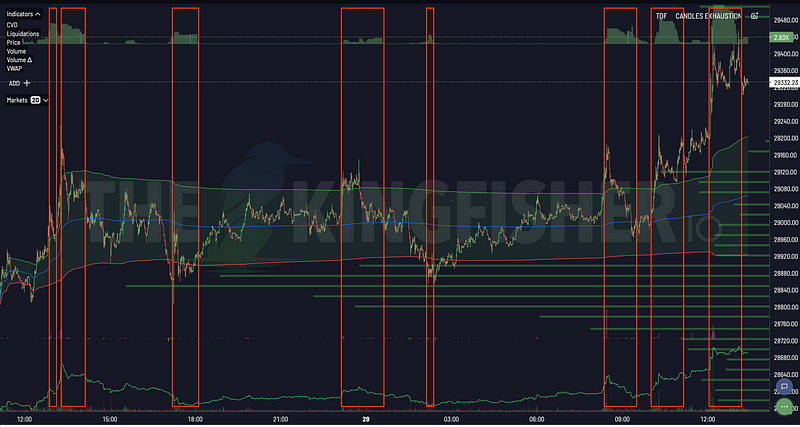
4. Check TOF (Toxic Order Flow)
- Are whales aggressively buying the dip? (TOF showing buy aggression despite red candles)
- Or is flow genuinely one-sided selling? (Real distribution, not FUD)
5. Historical Context
- Has this exact narrative played out before? (It probably has)
- What happened last time?
Real Scenario: FUD Hits Bitcoin
Headline: "Unnamed regulators preparing sweeping crypto crackdown"
Your screen: $BTC dumps 4% in 30 minutes. Timeline blowing up with panic.
Emotional reaction: Sell everything, this is it.
KF data reaction:
| Signal | Reading | Interpretation |
|---|---|---|
| OI | Rising (+$2B) | New shorts entering, not long selling |
| Funding | -0.04% | Shorts paying heavily to be short |
| TOF | Buy-side aggression | Whales absorbing the dip |
| LiqMap | $1.2B new long cluster formed at $60K | Fresh fuel below |
| GEX+ | Positive at current price | Dealer support zone |
Conclusion: Classic FUD setup. Shorts overcrowded, smart money buying, fresh liquidation fuel stacked below. This isn't a crash signal -- it's a loading zone.
Action: Scale into longs at key levels. Set stops below the new cluster. Target the short cluster above.
That's the difference between trading emotions and trading data.
Historical FUD Events: What Actually Happened
China "Ban" Cycles (2017, 2021)
FUD: "China bans Bitcoin mining!" "China bans crypto transactions!"
What actually happened: Mining relocated (didn't stop). Some retail restrictions applied. Market panicked temporarily. Then recovered to new highs within months.
Lesson: Regulatory FUD creates discounts. The miners didn't quit -- they moved. The buyers who held through the panic bought at 40% discounts.
Environmental FUD (2021)
FUD: "Bitcoin uses more energy than Argentina! It'll destroy the planet!"
What actually happened: Narrative gained traction temporarily. ESG-focused funds faced pressure. Then mining shifted toward renewables (which now make up majority of BTC mining energy mix). Narrative evolved. Price recovered.
Lesson: FUD narratives adapt. The underlying asset doesn't.
Exchange Collapse (2022) -- This One Was Real
Important caveat: Not all negative news is FUD. When an exchange actually collapses (and yes, this has happened), that's a legitimate crisis requiring real action.
Lesson: Distinguish between FUD (manipulative noise) and actual insolvency/risk events. Due diligence matters. Self-custody isn't optional.
Trading Strategies During FUD Events
Strategy 1: Fade the Panic (High-Quality FUD Only)
When to use: You've identified clear FUD markers (anonymous sources, vague timing, extreme language) AND data confirms contrarian setup (overcrowded shorts, whale buying).
Execution:
- Confirm FUD quality using the checklist above
- Wait for initial panic wave to exhaust (first 30-120 minutes)
- Enter scale-in longs at key support / cluster levels
- Size smaller than normal -- even high-probability FUD fades can go further than expected
- Target: pre-FUD price level or next major resistance cluster
Strategy 2: Size Based on FUD Quality
Not all FUD is the same. Size accordingly:
Low-quality FUD (obvious manipulation): Full position size. These reverse fast and hard. Medium-quality FUD (plausible but unverified): Half size. Wait for confirmation. High-quality FUD (legitimate concern with real risk): Reduce exposure or stand aside. Protect capital first.
Strategy 3: Time Diversification
During genuine uncertainty (even if you think it's overblown), don't YOLO all at once:
- First entry: 25% at initial support test
- Second entry: 25% if price holds and data improves
- Third entry: 25% on confirmed reversal signal
- Final 25%: On breakout confirmation
This protects you from the rare case where the FUD was actually early warning of something real.
Mental Framework: The Anti-FUD Mindset
Probability Over Emotion
Before reacting to any headline, ask:
- What's the probability this claim is true? (Be honest)
- What's the impact on price if it IS true? (Size accordingly)
- What's the expected value of my trade given both outcomes?
Most FUD has low probability of material impact but high emotional weight. That asymmetry is where disciplined traders profit.
Temporal Perspective
Will this headline matter in six months? A year? Most FUD is forgotten within weeks. The traders who sold at the bottom because of a tweet don't forget though -- they're still watching from the sidelines.
Information Hygiene
Reliable sources:
- Official project announcements (named individuals, specific details)
- Reputable news with verifiable sourcing
- On-chain data (doesn't lie, doesn't have feelings)
- Kingfisher analytics (objective, quantitative)
Noise sources to filter:
- Anonymous accounts breaking "exclusive" news
- Unverified rumors spreading through echo chambers
- Emotional content designed to trigger action, not inform
FAQ
Q: How can I quickly tell if a crypto news story is legitimate FUD or manufactured manipulation? A: Run it through the FUD quality checklist: (1) Is there a named, verifiable source? Anonymous "sources familiar with the matter" = red flag. (2) Are there specific dates, amounts, or regulatory citations? Vague timing ("soon," "in coming weeks") = manipulation pattern. (3) Is the language emotionally charged? Words like "catastrophic," "devastating," "unprecedented" are designed to trigger fear, not inform. (4) Does official on-chain data contradict the narrative? If FUD claims "whales dumping" but TOF shows aggressive whale buying, someone's lying -- and it's probably not the blockchain. Hit 3+ red flags and you're looking at manufactured FUD, not legitimate news.
Q: Should I ever act on FUD by selling, or is fading always the right move? A: Not always. Legitimate regulatory actions (actual SEC charges with named defendants, concrete legislation passing, exchange insolvencies with proof of reserves issues) deserve respect and position reduction. The key distinction: legitimate concerns come with specific details, named sources, and verifiable evidence. Manufactured FUD relies on anonymity, vagueness, and emotional language. Size your response accordingly: obvious manipulation FUD = fade aggressively (full or oversized position). Plausible but unverified = half size, wait for confirmation. Legitimate concern with real risk = reduce exposure or stand aside. Capital preservation beats contrarian cleverness when the risk is real.
Q: How does Kingfisher data help me distinguish real selling from panic-induced FUD dumps? A: Three signals separate real capitulation from FUD-driven panic: (1) Open Interest behavior -- if price dumps 10% but OI barely changes, it's spot selling/panic, not futures unwinding (often a bounce candidate). If OI collapses 30%+ alongside the dump, it's leveraged flush (stronger reversal signal). (2) Toxic Order Flow -- if TOF spikes hard to the buy side during the FUD dip, whales are accumulating through the panic (contrarian buy signal). If TOF is neutral or sell-aggressive, the dump may have real legs. (3) Funding rates -- deeply negative funding during a FUD dump means shorts are paying to be short and getting crowded (squeeze candidate). Flat or positive funding during a dump suggests measured selling, not panic.
Q: What's the historical success rate of fading crypto FUD? A: Across major FUD events from 2020-2025, well-identified manufactured FUD (passing the quality checklist above) has roughly a 70-80% reversal rate within 2-5 trading days. China FUD ("crypto banned again") reverses 85%+ of the time within a week. Exchange FUD (insolvency rumors without proof) reverses ~70% when on-chain data contradicts the narrative. Regulatory FUD with actual named actions is the exception -- only ~30-40% fade success rate because sometimes the regulation IS real and consequential. The pattern is clear: anonymous, vague, emotional FUD is almost always a buying opportunity. Named, specific, evidenced FUD deserves actual risk management.
Q: How do I stop myself from emotionally reacting to FUD headlines in the moment? A: Build a pre-commitment protocol BEFORE the next FUD event hits: (1) Mute or limit Twitter/crypto news during volatile periods. (2) Set a rule: no trading decisions within 30 minutes of reading any headline. (3) Create a FUD response checklist that MUST be completed before any action: verify source, check KF data (OI, funding, TOF, LiqMap), compare against your written criteria. (4) Position size limit for FUD-response trades (max half your normal size regardless of conviction). The goal isn't to eliminate emotional reaction (impossible) -- it's to insert a mandatory data-gathering step between stimulus and action. That 30-minute gap is where discipline lives.
Bottom Line
FUD is a permanent fixture in crypto markets. It's not going away. The question is whether you're the one selling into it or the one buying from the sellers.
What is FUD? It's a test. Every time. And the traders who pass -- who check the data instead of their emotions -- are the ones building positions while everyone else is panic-selling.
Kingfisher gives you the tools to make that distinction: open interest tells you who's positioning where, funding rates reveal crowd extremes, liquidation maps show where the fuel is stacked, and TOF exposes what whales are actually doing versus what Twitter says they're doing.
Trade the data. Not the headline.
Related Articles
- Liquidation Maps 2026: Complete Guide to Crypto Liquidation Heatmaps
- Open Interest Explained: What is Open Interest in Crypto Trading?
- Funding Rate Guide: Complete Guide to Crypto Funding
- Toxic Order Flow: Detecting Market Manipulation in Crypto
Learn to Read Liquidation Maps | Understand Open Interest | Start Free Trial | See All Kingfisher Tools
Transform Your Crypto Strategy
Harness The Power of The Kingfisher's Comprehensive Market Intelligence!

Glossary
Learn key terms and concepts from our comprehensive crypto trading glossary.
Browse Glossary →Related Articles
How to Detect Crypto Market Manipulation in Real-Time
Stop being played by whales. Learn to spot crypto manipulation before it costs you money using Kingfisher's Toxic Order Flow and liquidation data. Real examples included.

Getting Started on The Kingfisher: Stop Being Exit Liquidity
What problem does Kingfisher solve? See how liquidation maps reveal where price will go BEFORE it moves there. Stop getting hunted by whales. Start trading with an edge in 10 minutes.
Toxic Order Flow Bitcoin: Detect Market Manipulation in Real-Time
Stop being exit liquidity. Learn how toxic order flow (TOF) reveals when whales are hunting retail traders. Practical guide with step-by-step interpretation and trading strategies.

Options Skew Templates for Perp Traders: Complete Guide to Using Skew Data on Kingfisher
Master options skew data for perpetual futures trading. Learn how to read and use Skew templates on Kingfisher, understand different template types (Basic, Vanilla, Premium), when each template works best, and how to combine skew analysis with LiqMap confirmation for high-probability crypto trading setups.