

Exhaustion Candles: How to Spot Market Reversals in Crypto
Introduction: The Final Push Before Reversal
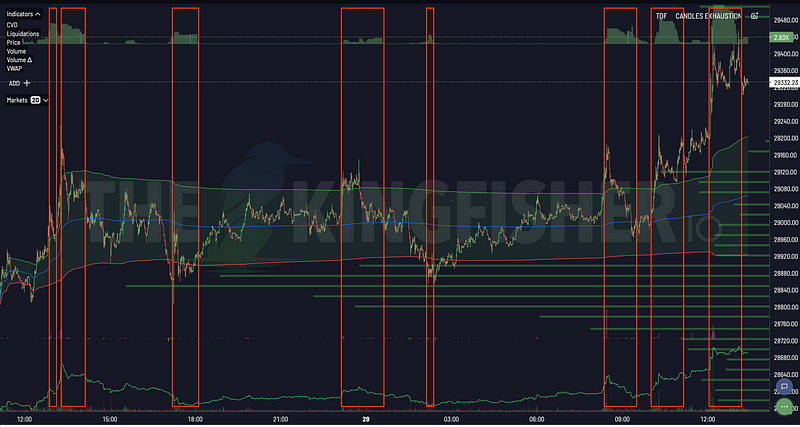
You've seen it before: Price trends strongly in one direction, then suddenly produces a massive candle – the largest of the move. Most traders see this as confirmation. They FOMO in, expecting continuation.
They're wrong.
That massive candle is often an exhaustion candle – the final push before a reversal. Smart money uses this surge to exit positions, while retail chases the move.
In this guide, you'll learn what exhaustion candles are, how to identify them reliably, and how to confirm reversals using liquidation maps and V Charts to avoid fakeouts.
What Are Exhaustion Candles?
Defining Exhaustion
Exhaustion candles are a specific type of candlestick pattern that represents:
- The final surge of buying or selling pressure
- Capitulation – last traders jumping in (or out)
- Climactic volume – everyone who will act has acted
- Exhausted momentum – no fuel left for continuation
The key insight: The candle looks strong (large range, high volume), but it marks the END of the move, not the beginning.
Why Exhaustion Candles Form
Psychology behind exhaustion:
- Trend phase: Price moves steadily, early participants profit
- Acceleration phase: Late participants notice, FOMO begins
- Exhaustion phase: Final surge – everyone jumps in
- Reversal: No one left to buy (or sell) – price reverses
Example (Bullish Exhaustion):
- BTC trends from $45,000 → $48,000
- Suddenly produces massive green candle to $49,500
- Volume huge – everyone buying
- Exhaustion: No buyers left
- BTC reverses to $47,000
How to Identify Exhaustion Candles
Visual Characteristics
Exhaustion candles typically show:
- Unusually large range – 2-3x average candle size
- Extreme volume – Highest of the entire move
- Long wicks – Rejection at the extremes
- Gap from previous candles – Disconnected from price action
- Climactic feel – "This can't last" appearance
On a V Chart:
- Single V-candle with massive time component
- Represents enormous volume in short period
- Stands out from surrounding V-candles
Quantitative Identification
Exhaustion candle criteria:
- Range: >2x average true range (ATR)
- Volume: >2x average volume
- Position: After extended trend (10+ candles)
- Location: At key levels (support and resistance, liquidation clusters)
Example:
- BTC average ATR: $500
- Current candle range: $1,500 (3x ATR)
- Volume: 2.5x average
- After 15-candle uptrend
- At $50,000 resistance
- Verdict: Exhaustion candle likely
Check the LiqMap at that level -- if there's a major cluster at $50,000, the exhaustion candle is likely fueling liquidations rather than a breakout.
Exhaustion Candles vs. Other Reversal Patterns
Exhaustion vs. Pin Bars
Pin bars:
- Small body, long wick
- Show rejection at a level
- Can occur anytime (not necessarily after trends)
Exhaustion candles:
- Large body, large range
- Show climactic buying/selling
- Only after extended trends
Key difference: Pin bars = rejection. Exhaustion = capitulation.
Exhaustion vs. Engulfing Patterns
Engulfing patterns:
- One candle engulfs previous
- Show momentum shift
- Can occur at minor reversals
Exhaustion candles:
- One candle represents entire trend's climax
- Show momentum exhaustion
- Mark MAJOR reversals
Key difference: Engulfing = shift. Exhaustion = ending.
Exhaustion vs. Breakout Candles
Breakout candles:
- Occur at key levels
- Start new trends
- Confirmed by continuation
Exhaustion candles:
- Occur after extended trends
- End existing trends
- Confirmed by reversal
Key difference: Breakouts = beginning. Exhaustion = ending.
This is why confirmation is critical – large candles alone don't tell you which is which.
Confirming Exhaustion Candles with Liquidation Maps
The Confirmation Problem
The challenge: Large candles can be:
- Exhaustion (reversal coming)
- Breakouts (continuation coming)
- Fakeouts (traps)
You need confirmation to avoid trading false signals.
Liquidation Map Confirmation
Exhaustion at Liquidation Cluster:
- Price trends into large liquidation cluster
- Massive candle triggers liquidations
- Liquidations fuel the candle (not new money)
- Once liquidations clear → reversal
Example:
- BTC uptrend to $48,000
- $600M long liquidation cluster at $48,500
- BTC produces massive candle to $48,500
- Longs liquidated, fueling the move
- Exhaustion: Liquidations done, no buyers left
- BTC reverses to $47,000
How to confirm:
- Identify large candle (potential exhaustion)
- Check Liquidation Map – is price at cluster?
- If yes → Exhaustion likely, reversal probable
- If no → Could be breakout, wait for confirmation
Real-World Example
BTC – March 2024:
Setup:
- BTC uptrend from $65,000 → $69,000
- Massive green candle to $70,000
- Volume: 3x average
Liquidation Map Analysis:
- $800M short liquidation cluster at $70,000
- Price reached cluster exactly
- Candle fueled by short-covering
Confirmation: Exhaustion candle Result: BTC reversed to $67,500
Using V Charts to Spot Exhaustion
Why V Charts Are Superior
Time-based charts:
- Many small candles during low volume
- Compression of information
- Exhaustion less obvious
V Charts:
- Each candle = fixed volume
- Low volume periods = few candles
- High volume periods = many candles
- Exhaustion stands out clearly
V Chart Exhaustion Patterns
Pattern 1: Single V-Candle Explosion
- Normal: 5-10 V-candles per hour
- Exhaustion: 1 V-candle represents 1 hour's volume
- Time component: Massive
- Signal: Climactic volume, exhaustion
Pattern 2: Sequential Compression Then Expansion
- Phase 1: Many small V-candles (struggle)
- Phase 2: Few medium V-candles (consolidation)
- Phase 3: ONE massive V-candle (exhaustion)
- Signal: Transition from struggle to climax
Pattern 3: Time Expansion
- Normal V-candle: 5-10 minutes
- Exhaustion V-candle: 30-60 minutes
- Same volume, much longer time
- Signal: Market absorbing last surge, exhaustion
Trading Exhaustion Candle Signals
Strategy 1: Fade the Exhaustion Candle
Concept: Trade the reversal after exhaustion.
Setup:
- Extended trend (10+ candles in one direction)
- Massive candle forms (2-3x ATR)
- Liquidation Map: Price at cluster
- Toxic Flow: Elevated (whales exiting)
Entry: On reversal signal
- Bearish exhaustion: Enter short on break of exhaustion candle low
- Bullish exhaustion: Enter long on break of exhaustion candle high
Stop: Beyond exhaustion candle extreme
- Bearish: Above exhaustion candle high
- Bullish: Below exhaustion candle low
Target: Return to pre-exhaustion level or next support/resistance
Why it works: Exhaustion = last surge. Reversal follows as momentum dies.
Strategy 2: Wait for Pullback to Exhaustion Level
Concept: Exhaustion level becomes new support/resistance.
Setup:
- Exhaustion candle forms
- Price reverses
- Wait for pullback to exhaustion level
Entry: On rejection at exhaustion level
- Show. candle wick or rejection pattern
- Confirm with Liquidation Map (cluster still there?)
Stop: Beyond exhaustion level
Target: Re-test of recent extremes
Why it works: Exhaustion level = climactic point. Market respects it.
Strategy 3: Exhaustion + Toxic Flow Combo
Concept: Use Toxic Flow to time entries.
Setup:
- Potential exhaustion candle forms
- Check Toxic Flow – is it elevated?
- If yes → Whales exiting, exhaustion confirmed
- Wait for Toxic Flow to drop
- Enter reversal
Why it works: Toxic Flow shows if the surge is real or manipulation.
Exhaustion Candle Strategy Examples
Example 1: BTC Bullish Exhaustion – June 2024
Setup:
- BTC downtrend from $50,000 → $45,000
- Massive red candle to $44,000
- Volume: 2.8x average
Confirmation:
- Liquidation Map: $500M long cluster at $44,500
- Price pushed through cluster, fueled by liquidations
- Toxic Flow: 75 (elevated, whales dumping)
Signal: Bearish exhaustion Entry: Short on break of $44,500 (reversal confirmed) Stop: Above $45,000 (exhaustion high) Target: $47,000 (return to pre-exhaustion level)
Result: BTC reversed to $47,200, profit achieved
Example 2: ETH Bullish Exhaustion – Fakeout Avoided
Setup:
- ETH consolidation at $3,000
- Large green candle to $3,200
- Volume: 2x average
Initial thought: Bullish breakout Liquidation Map check:
- No significant clusters at $3,200
- Volume: Moderate, not climactic
- Toxic Flow: 25 (normal)
Conclusion: NOT exhaustion – likely breakout Action: Avoid shorting, wait for continuation
Result: ETH continued to $3,400 (fake exhaustion avoided)
Common Mistakes When Trading Exhaustion Candles
Mistake 1: Trading Every Large Candle
Problem: "That's a huge candle! Must be exhaustion!"
Reality: Large candles can be breakouts, not exhaustion.
Solution: Confirm with:
- Extended trend before the candle?
- Liquidation cluster at that level?
- Elevated toxic flow (whales exiting)?
- V Chart showing climactic volume?
If no to these → not exhaustion.
Mistake 2: Entering Too Early
Problem: "That's exhaustion! I'll short immediately!"
Reality: Exhaustion can continue longer than expected. Fading too early = stopped out.
Solution:
- Wait for reversal signal
- Let candle close
- Confirm with break of candle extreme
- Don't anticipate – react
Mistake 3: Ignoring Context
Problem: Trading exhaustion patterns in isolation.
Reality: Exhaustion doesn't work in:
- Strong trending markets (exhaustion fails, trend resumes)
- Low volatility (no climactic volume possible)
- News events (exhaustion overrun by catalysts)
Solution: Only trade exhaustion when:
- Trends are extended
- Volatility is elevated
- No major news pending
Exhaustion Candles + Kingfisher Tools
Complete Confirmation Framework
Step 1: Visual Identification
- Large candle (2-3x ATR)
- High volume (2x average)
- After extended trend
Step 2: Liquidation Map Confirmation
- Price at liquidation cluster?
- Cluster fueling the move?
- If yes → Exhaustion likely
Step 3: V Chart Confirmation
- Single massive V-candle?
- Time expansion?
- Climactic volume?
- If yes → Exhaustion confirmed
Step 4: Toxic Flow Confirmation
- Elevated toxicity (whales exiting)?
- Cross-exchange imbalance?
- If yes → Exhaustion trade validated
Only when ALL FOUR confirm → Trade the reversal.
Backtesting Exhaustion Strategies
What to test:
- Success rate: How often do exhaustion candles lead to reversals?
- Optimal holding period: How long until reversal completes?
- Best market conditions: Trending? Ranging? Volatile?
- Stop loss placement: How far beyond exhaustion extreme?
- Target selection: How far to set profit targets?
Kingfisher backtesting tools:
- Historical V Chart data
- Past liquidation maps
- Toxic flow history
- Export results for analysis
FAQ
Q: How can I tell the difference between an exhaustion candle and a legitimate breakout candle? A: Four distinguishing factors: (1) Trend context -- exhaustion occurs AFTER an extended trend (10+ consecutive candles in one direction). Breakouts occur FROM consolidation, not after extended runs. (2) Volume profile -- exhaustion shows climactic volume (2-3x average) on V-charts as a single massive candle representing hours of normal volume. Breakouts show expanding volume but distributed across multiple candles. (3) LiqMap location -- exhaustion candles typically form AT or near major liquidation clusters (the final cascade fueling the last surge). Breakouts happen AWAY from clusters into open space. (4) Toxic Flow -- exhaustion shows elevated ToF (whales exiting/reversing). Breakouts show elevated ToF in the breakout DIRECTION (whales committing). If all four point to exhaustion, fade it. If mixed or contradictory, wait.
Q: What's the historical success rate of fading exhaustion candles in crypto? A: Across BTC and ETH on 4-hour and daily timeframes from 2021-2025, properly confirmed exhaustion candles (meeting all 4 criteria: extended trend + climactic volume + cluster proximity + elevated ToF) reverse approximately 65-72% of the time within 5-15 candles. The key variable is timeframe: daily exhaustion candles reverse more reliably (~72%) than 4H ones (~65%) because daily climaxes represent more exhausted participation. The biggest source of failed fades is trading exhaustion in strong trending markets -- during sustained bull runs, "exhaustion" candles just become brief pullbacks before resumption. Always confirm trend strength via OI and GEX+ before fading.
Q: How does Kingfisher's V-charting tool help identify exhaustion candles? A: V-charts (volume-based charts where each candle represents fixed volume instead of fixed time) make exhaustion visually obvious in ways time-based charts cannot. On a regular chart, an exhaustion candle looks like a big red/green candle among other big candles. On a V-chart, exhaustion appears as ONE massive candle representing what normally takes 5-10 candles worth of volume compressed into a single price action unit. That visual compression is the exhaustion signature: the market expended a week's worth of energy in one burst. Kingfisher's V-chart tool overlays this directly with LiqMap clusters so you can see both the climactic volume AND the cluster level simultaneously.
Q: Should I enter the exhaustion fade immediately or wait for confirmation? A: WAIT for confirmation. The #1 mistake in exhaustion trading is anticipation -- shorting the moment you see a big candle before it closes or before reversal is confirmed. Exhaustion can persist longer than expected (especially in momentum-driven crypto markets). The correct sequence: (1) Identify potential exhaustion candle (size + volume + trend extension). (2) Confirm with LiqMap (at cluster?), V-chart (climactic compression?), ToF (elevated exit flow?). (3) WAIT for reversal signal -- break of exhaustion candle extreme, engulfing pattern, or clear rejection wick. (4) Enter on confirmation, not anticipation. Your entry will be slightly worse price-wise but your win rate improves dramatically. Patience beats early entry every time here.
Q: Do exhaustion candles work the same way in ranging markets versus trending markets? A: No, and this distinction is critical. In RANGING markets (confirmed by oscillating price, flat OI, neutral funding), exhaustion candles at range boundaries are highly reliable fade signals -- the range contains price and climactic moves at boundaries almost always reverse. In TRENDING markets (rising OI with price, directional funding bias), exhaustion candles are dangerous fade candidates -- what looks like exhaustion is often just a deeper pullback before trend resumption. Before fading ANY exhaustion candle, first classify the market regime using OI trends and GEX+. Only fade exhaustion in ranges or at extreme trend extensions (parabolic moves on declining volume). In healthy trends, treat large candles as continuation signals, not reversal signals.
Conclusion: Spot Reversals Before They Happen
Exhaustion candles are the market's way of signaling "enough!" – the final surge before momentum dies.
Mastering exhaustion candles gives you:
- Reversal anticipation – See reversals before they complete
- Entry precision – Time entries at climactic points
- Fakeout avoidance – Distinguish exhaustion from breakouts
- Edge over retail – Trade with institutional awareness
Combine with:
- Liquidation Maps -- Confirm exhaustion at clusters
- V Charts -- Spot climactic volume clearly
- Toxic Flow -- Know when whales are exiting
For traders who keep getting caught in these cascades, our guide on how to stop getting liquidated covers position placement strategies that keep you out of the danger zone.
Stop chasing moves. Start anticipating reversals.
Ready to spot exhaustion before it happens? Explore Kingfisher features or see pricing.
Related Articles
- Liquidation Maps: The Complete Guide
- The Kingfisher Scalping Toolbox
- How to Stop Getting Liquidated Before Major Moves
- V-Charting Complete Guide
Check V Chart for exhaustion signals →
Transform Your Crypto Strategy
Harness The Power of The Kingfisher's Comprehensive Market Intelligence!

Glossary
Learn key terms and concepts from our comprehensive crypto trading glossary.
Browse Glossary →Related Articles

Getting Started on The Kingfisher: Stop Being Exit Liquidity
What problem does Kingfisher solve? See how liquidation maps reveal where price will go BEFORE it moves there. Stop getting hunted by whales. Start trading with an edge in 10 minutes.
Toxic Order Flow Bitcoin: Detect Market Manipulation in Real-Time
Stop being exit liquidity. Learn how toxic order flow (TOF) reveals when whales are hunting retail traders. Practical guide with step-by-step interpretation and trading strategies.

Options Skew Templates for Perp Traders: Complete Guide to Using Skew Data on Kingfisher
Master options skew data for perpetual futures trading. Learn how to read and use Skew templates on Kingfisher, understand different template types (Basic, Vanilla, Premium), when each template works best, and how to combine skew analysis with LiqMap confirmation for high-probability crypto trading setups.

How to Detect Crypto Market Manipulation in Real-Time
Stop being played by whales. Learn to spot crypto manipulation before it costs you money using Kingfisher's Toxic Order Flow and liquidation data. Real examples included.