

V-Charting Complete Guide: Volume Profile Trading for Crypto
Price Tells Half the Story. Volume Tells the Rest.
Most traders look at a chart and see price moving up and down. They draw lines, they spot patterns, they feel like they understand what's happening.
They don't. Not really.
Price without volume is like watching a movie with the sound off. You can see what's happening, but you have no idea WHY it's happening or whether it means anything.
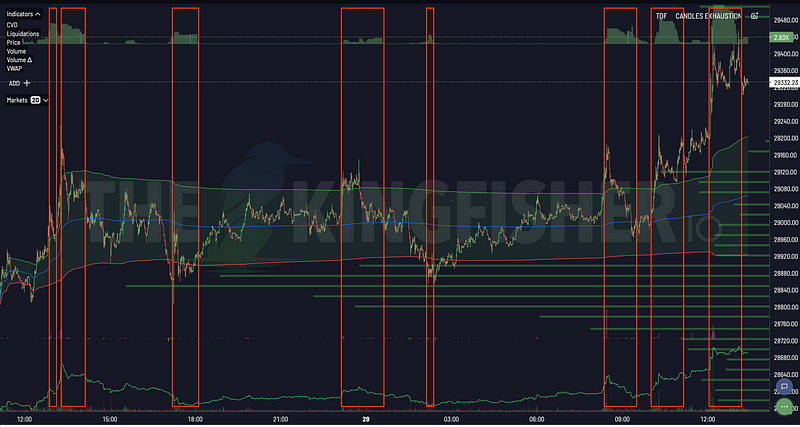
V-Charting (Volume Profile Charting) adds the sound back. It shows you WHERE volume was actually traded at each price level -- creating a horizontal histogram that reveals the market's true structure. Support and resistance based on real capital deployment, not arbitrary lines drawn at past price peaks.
When you combine V-Charting with Kingfisher's liquidation data, you're looking at the same picture institutions see: where money traded, where positions sit, and where price is likely to go next.
The Building Blocks
POC (Point of Control): The Fairest Price
The POC is the price level with the highest traded volume in your selected time period. It's where the deepest liquidity sits. Where buyers and sellers agreed most strongly on value.
Why POC matters:
- Price acts like it's drawn to POC -- gravitational pull
- Strongest single support/resistance level on the chart
- First place to check when price approaches
Trading rule: When price drifts far from POC, expect reversion pressure. Not guaranteed -- but statistically probable over enough trades. The further from POC, the stronger the pull back.
Value Area (VA): The Acceptance Zone
The Value Area covers ~70% of all volume traded (one standard deviation from POC). Its boundaries:
- VAH (Value Area High) -- Upper limit of accepted value
- VAL (Value Area Low) -- Lower limit of accepted value
- POC lives inside, usually near center
Inside VA = Fair value. Participants accept these prices. Two-way market. Good for range trading.
Outside VA = Unfair value. Market rejecting these prices. One side dominates. Good for fade trades (betting on return to fair value).
HVN and LVN: Thick and Thin Zones
High Volume Nodes (HVN): Price levels with exceptionally thick volume bars. These are areas where price spent time consolidating. Lots of trading, little movement.
- Trading implication: Price moves SLOWLY through HVNs. Consolidation zones. Act as support/resistance.
- Best trade: Range-bound strategies within HVN bounds.
Low Volume Nodes (LVN): Price levels with minimal volume. Price rejected these areas quickly. Thin liquidity.
- Trading implication: Price moves QUICKLY through LVNs. Fast zones. Little support/resistance.
- Best trade: Breakout entries targeting the next HVN or cluster. Price accelerates through thin areas.
Reading a Volume Profile
Session Profile (Single Day)
Example: $BTC Daily Profile
POC:        $67,500 (thickest bar, most volume)
Value Area: $65,500 - $69,500 (70% of day's volume)
VAH:        $69,500
VAL:        $65,500
HVN:        $66,800 - $68,200 (consolidation zone)
LVN above:  $71,000+ (thin area, fast move if reached)
LVN below:  $63,500- (thin area below)
How to trade this:
- Price currently at $70,200 (above VAH) → Overextended, unfair value → Look for short entry or wait for pullback to VA
- Price at $64,200 (below VAL) → Oversold, unfair value → Look for long entry or wait for bounce to VAL
- Price at $67,300 (near POC) → Fair value → Wait for directional signal before committing
Composite Profile (Multiple Sessions)
Aggregate volume across days/weeks/months:
- Weekly composite -- Stronger levels than daily. Filters out daily noise.
- Monthly composite -- Strongest levels. Institutional timeframe.
Rule: Monthly POC > Weekly POC > Daily POC in terms of significance. If daily POC is $67K but monthly POC is $63K, and price is grinding around $66K? The monthly level will eventually assert itself. Trade accordingly.
Volume Profile Trading Strategies
Strategy #1: Value Area Fade
Concept: Price outside Value Area tends to return inside.
Setup:
- Price trades above VAH (or below VAL)
- Signs of rejection at the extreme (long wick, volume drying up)
- Reversal signal (candle pattern, ToF drop)
Entry: Short if above VAH turning down. Long if below VAL turning up. Stop: Beyond the recent extreme (outside VA). Target: POC (most likely destination).
Real example ($BTC):
- Daily VA: $65K-$68K, POC: $66,500
- Price spikes to $69,800 (above VAH)
- Rejection candle: Long wick to $70,200, close at $69,400
- Volume at $70K+: Thin (LVN confirmed)
- Entry: Short at $69,200
- Stop: $70,600 (above rejection high)
- Target: POC at $66,500
- R:R: 1:2.7
Why it works: Price at $69,800 is "unfair value" -- sellers dominated, buyers absent. Natural gravitational pull back toward POC where liquidity is deepest.
Strategy #2: POC Bounce
Concept: POC acts as the strongest S/R level.
Setup:
- Well-established POC from previous session(s)
- Price approaches POC from either direction
- Clear rejection candle at POC
Entry: Long bouncing up from POC. Short rejecting down from POC. Stop: Beyond POC (give it room -- POC is a ZONE, not a line). Target: Opposite VA boundary.
Real example ($ETH):
- Daily POC: $2,950
- Price drops from $3,150 to $2,920
- Strong bullish rejection at POC (hammer candle, volume spike)
- Entry: Long at $2,960
- Stop: $2,915 (below POC body)
- Target: VAH at $3,080
- R:R: 1:2.4
Strategy #3: HVN Breakout / LVN Target
Concept: Price breaks out of consolidation (HVN) and accelerates through thin zones (LVN).
Setup:
- Price consolidating in HVN (thick volume zone)
- Clean breakout with volume confirmation
- Next LVN identified as target
Entry: On breakout or breakout retest Stop: Inside the HVN (failed breakout = back inside consolidation) Target: Next LVN (fast move expected)
Real example ($SOL):
- HVN: $145-$152 (5-day consolidation, thick bars)
- LVN above: $158+ (thin area on weekly profile)
- Breakout: $152 cleared with volume
- Entry: Long at $153 (retest of breakout)
- Stop: $149 (inside HVN)
- Target: LVN at $158
- R:R: 1:1.25 (modest but high probability)
Note: LVN targets are fast moves. Take profit quickly. Don't hold through LVN hoping for more -- the next HVN might be far away.
Volume Profile + LiqMap: The Confluence Engine
This is where V-Charting becomes an institutional-grade tool.
Scenario 1: POC + Liquidation Cluster (Maximum Strength)
Setup:
- Volume Profile POC at $49,000
- LiqMap shows $500M long liquidations at $48,800-$49,200
- Both overlap almost perfectly
Interpretation: This is the strongest support level you'll see on any chart. Historical volume says $49K is fair value. Current positions say $49K is where longs get wrecked (creating buying pressure). Double confirmation.
Trade: High-conviction long if price approaches from above. Stop below the cluster zone. Target: next HVN or short cluster above.
Scenario 2: LVN Above + Short Cluster (Defined Target)
Setup:
- LVN at $52,000 (thin volume area above current price)
- Short liquidation cluster at $51,800-$52,300 ($200M)
Interpretation: If price breaks through current resistance and reaches $52K, there's nothing slowing it down (LVN = thin) UNTIL the short cluster at $52K+. That cluster becomes both target and potential reversal point.
Trade: Long breakout play. Target the cluster. Exit (or take partial profits) as price enters cluster zone. Don't assume break-through unless ToF confirms strong continuation.
Scenario 3: Wide VA + No Clusters (Clean Range)
Setup:
- Weekly VA: $47K-$51K (wide = uncertainty)
- No major clusters inside VA
- Price at $48K
Interpretation: Clean range with no cascade risk. Good environment for range trading within VA. Set stops at VA boundaries. Targets at opposite boundary.
Trade: Buy near VAL ($47K), sell near VAH ($51K). Repeat until VA narrows (profile developing) or breaks (new trend starting).
V-Charts vs Time-Based Charts: Why V Wins for Certain Things
Spotting Exhaustion
On a time-based 1-hour chart, a big green candle looks like momentum. Is it? Or is it exhaustion?
On a V-Chart, you know immediately:
- Normal V-candle: Standard volume for the time period
- Massive V-candle: Same volume compressed into one candle = climactic volume = exhaustion signal
- Time-expanded V-candle: Same volume taking much longer than normal = absorption (smart money taking other side)
Exhaustion candles stand out on V-charts like flares in the night sky. On time-based charts, they blend in with normal candles until after the fact.
Seeing Absorption
Price drops $2,000 on heavy selling volume... but barely moves on the next $1,000 drop because every sell order gets absorbed by hidden buy orders.
Time-based chart: Shows two red candles. Looks bearish. V-Chart: Shows one massive V-candle (the drop) followed by many tiny V-candles (the absorption phase -- same volume taking forever because someone is eating every sell order).
That second pattern = smart money accumulating. The V-chart makes it visible. Time charts hide it in compression.
Kingfisher's V-Chart tool is purpose-built for this. Combined with CVD (Cumulative Volume Delta), you can distinguish between aggressive selling that moves price (toxic flow) and aggressive selling that gets absorbed (smart money accumulation). The difference is everything.
Advanced Concepts
Profile Shifting (Trend Detection via POC)
Track POC across multiple sessions:
- Rising POCs = Uptrend (fair value climbing). Trade pullbacks to new POCs.
- Falling POCs = Downtrend (fair value dropping). Sell rallies to new POCs.
- Flat POCs = Range (fair value stable). Trade the range boundaries.
This is one of the cleanest trend detection methods available -- no indicators needed, just POC progression.
Profile Shape Analysis
Balanced (bell curve): Market in equilibrium. Range-bound. P-shape (heavy lows): Accumulation. Smart money buying dips. Bullish bias. b-shape (heavy highs): Distribution. Smart money selling rips. Bearish bias.
Shape analysis tells you what smart money has been doing before price makes its next move. Combine with LiqMap clusters to know where that accumulated/distributed position wants to take price next.
Common Mistakes
Mistake 1: Trading LVN as S/R
LVN = Low Volume Node = thin area = price moves THROUGH it fast.
Some traders see LVN and think "support/resistance!" No. LVN is where support/resistance FAILS. That's the point -- price blows through it because nobody traded there.
Correct use: Trade LVN BREAKOUTS (enter in direction of the break), not LVN bounces. Or use LVN as a target (price will reach it quickly), not as an entry.
Mistake 2: Daily POC Worship
Daily POCs shift constantly. In a trending market, yesterday's POC is irrelevant today. Always check:
- Is this POC confirmed by higher timeframes?
- Has OI structure changed since this POC formed?
- Are there clusters reinforcing or contradicting this level?
Daily POC alone = weak signal. Daily POC + weekly POC alignment + cluster confluence = strong signal.
Mistake 3: Ignoring Context
A beautiful POC bounce setup at $67,500... during an FOMC announcement day with funding at +0.08% and OI at all-time highs.
Context kills setups. Check the full picture (macro calendar, funding extremes, OI concentration) before trusting any profile signal.
FAQ
Q: What's the difference between Volume Profile (V-charting) and regular volume bars on candlestick charts? A: Regular volume bars show total volume PER CANDLE (time-based). Volume Profile shows volume DISTRIBUTED ACROSS PRICE LEVELS (price-based). A candlestick tells you 500 BTC traded between 14:00-15:00. Volume Profile tells you 200 of those BTC traded at $67,200, 150 at $67,300, and 50 was spread across other prices. That price-level granularity reveals POC (fair value), HVNs (acceptance zones), and LVNs (rejection/gap zones) that time-based volume completely hides. It's the difference between knowing activity happened and knowing WHERE it happened.
Q: Which Volume Profile timeframe should I use for day trading vs swing trading? A: Day trades: use session Volume Profile (resets each exchange session, typically 00:00 UTC). Look for intraday POCs and VA developments within the current session's data. Swing trades: use rolling Volume Profiles (last 20-50 sessions) or composite profiles that build over multiple days. The key principle: match your profile period to your holding period. Don't make swing trading decisions off a 2-hour-old intraday profile, and don't day trade off a stale weekly profile that formed three weeks ago.
Q: How do I combine V-charting with Kingfisher's Liquidation Map? A: They're powerful complements. V-charting shows where volume HAS been concentrated (historical acceptance/rejection). LiqMap shows where leveraged positions WILL cascade (future fuel). When a V-chart HVN (High Volume Node -- strong acceptance zone) aligns with a LiqMap cluster, you have double confirmation: the market has historically accepted this price AND billions in positions will react there. Trade toward these confluence zones. Conversely, if V-chart shows a LVN (thin area = fast passage) but LiqMap shows a massive cluster in that same zone, the cluster usually wins -- liquidity vacuum overrides volume profile thinness when real money is at stake.
Q: What's the biggest mistake new V-charters make? A: Treating Low Volume Nodes (LVN) as support/resistance levels. LVNs are areas where price moved THROUGH quickly because nobody traded there. That means they're weak zones, not strong ones. The correct play: enter on LVN breakouts (price is already moving through thin air, momentum continues) OR target LVNs as exit points (price reaches them quickly). Never enter AT an LVN expecting a bounce -- that's fighting the exact pattern the data shows. HVNs (High Volume Nodes) are your bounce/catch zones. LVNs are your breakout/target zones.
Q: Do I need special software for Volume Profile or can I see it on Kingfisher? A: Kingfisher includes built-in Volume Profile tools with POC, Value Area, HVN/LVN visualization directly integrated with LiqMap data. You don't need separate charting platforms or paid add-ons. The V-charting tools on Kingfisher overlay volume distribution onto the same view as liquidation clusters, so you can see historical volume acceptance alongside future liquidation fuel in one place. Start with the free trial -- the V-charting module is included in all tiers.
Bottom Line
Volume Profile reveals what traditional charts cannot: where the REAL trading happened, not just where price wandered. POC gives you the truest support/resistance level. Value Area tells you what's fair and what's extended. HVN/LVN tell you where price will move fast versus slow.
Combine this with Kingfisher's liquidation data (where leveraged positions create future fuel), GEX+ (how dealers position themselves), and ToF (when manipulation is active), and you stop reading charts. You start reading market structure.
The best traders don't predict price better than you. They understand structure better. Structure is learnable. Start here. Explore Kingfisher's full toolkit or compare plans.
Access Free Volume Profile Tools
Related Articles
Transform Your Crypto Strategy
Harness The Power of The Kingfisher's Comprehensive Market Intelligence!

Glossary
Learn key terms and concepts from our comprehensive crypto trading glossary.
Browse Glossary →Related Articles
Toxic Order Flow Bitcoin: Detect Market Manipulation in Real-Time
Stop being exit liquidity. Learn how toxic order flow (TOF) reveals when whales are hunting retail traders. Practical guide with step-by-step interpretation and trading strategies.

How to Detect Crypto Market Manipulation in Real-Time
Stop being played by whales. Learn to spot crypto manipulation before it costs you money using Kingfisher's Toxic Order Flow and liquidation data. Real examples included.

Getting Started on The Kingfisher: Stop Being Exit Liquidity
What problem does Kingfisher solve? See how liquidation maps reveal where price will go BEFORE it moves there. Stop getting hunted by whales. Start trading with an edge in 10 minutes.

Options Skew Templates for Perp Traders: Complete Guide to Using Skew Data on Kingfisher
Master options skew data for perpetual futures trading. Learn how to read and use Skew templates on Kingfisher, understand different template types (Basic, Vanilla, Premium), when each template works best, and how to combine skew analysis with LiqMap confirmation for high-probability crypto trading setups.